Paediatric Cochlear Implant Surgery in India: Guide for African Families 2026

Paediatric Cochlear Implant Surgery in India: Complete Guide for African Families 2026
Every child deserves to hear their parent's voice. For children with profound hearing loss, cochlear implant surgery is often the closest medicine comes to granting that experience — and India has emerged as one of the world's most capable and cost-accessible destinations for this life-changing procedure.
Across Nigeria, Kenya, Ghana, Ethiopia, and beyond, families with deaf or severely hard-of-hearing children are discovering that the care they need does not require travel to Europe or North America. India's cochlear implant centres — led by AIIMS Delhi, Apollo Hospitals, and Fortis — perform hundreds of implants annually with outcomes that match international benchmarks, at costs that are 60–75% lower than Western alternatives.
Quick numbers: Unilateral cochlear implant in India: $12,000–18,000. Bilateral: $20,000–30,000. USA equivalent: $50,000–80,000 per ear. Remote programming available for follow-up after returning home.
This guide covers everything African families need to understand: candidacy, the procedure itself, costs, the best hospitals, programming and follow-up, and how Arodya coordinates the entire process.
What Is a Cochlear Implant?
A cochlear implant is an electronic device that bypasses damaged hair cells in the inner ear (cochlea) and directly stimulates the auditory nerve, creating the sensation of sound. Unlike hearing aids, which amplify sound, cochlear implants work even when the cochlea is severely or profoundly damaged.
The device has two parts. The internal component — a receiver/stimulator and electrode array — is surgically implanted under the skin behind the ear, with the electrode array threaded into the cochlea. The external component — a sound processor worn behind the ear — picks up sound, converts it to digital signals, and transmits these wirelessly to the internal device.
Modern cochlear implants from Cochlear (Australia), MED-EL (Austria), and Advanced Bionics (USA) are sophisticated, durable devices with processor upgrades available as technology advances. All three brands are available in India's leading implant centres.
Who Is a Candidate for Cochlear Implant?
Candidacy assessment is thorough, typically taking 2–3 days of evaluation at the Indian centre before surgery is planned.
For children, the key criteria are:
- Bilateral profound sensorineural hearing loss (hearing thresholds worse than 90 dB in both ears)
- Age 12 months or older (some centres implant from 9 months in exceptional cases)
- No benefit from optimised hearing aids after a formal trial (typically 3–6 months)
- No medical contraindications to surgery or general anaesthesia
- Family commitment to the post-implant auditory rehabilitation programme
For older children and adolescents, candidacy extends to those with severe-to-profound hearing loss who have had limited benefit from hearing aids, or those who have acquired hearing loss (meningitis, trauma, or progressive conditions).
For adults, cochlear implants are also effective, particularly for individuals who had hearing before its loss (post-lingual deafness). Age is not a barrier.
The evaluation includes pure tone audiometry, auditory brainstem response (ABR) testing, CT and MRI of the temporal bones to assess cochlear anatomy, and a hearing aid trial assessment. These investigations determine whether cochlear implant is appropriate and whether any anatomical challenges (cochlear ossification from meningitis, Mondini dysplasia) require special surgical planning.
The Surgery: What Happens
Cochlear implant surgery is performed under general anaesthesia and takes 2–3 hours per ear. The surgeon makes a small incision behind the ear, creates a recess in the bone behind the ear canal, and drills a small opening into the cochlea through the mastoid. The electrode array is gently threaded into the cochlea, and the receiver/stimulator is secured in the bone pocket.
Intraoperative monitoring (ECAP — electrically evoked compound action potential) confirms the device is functioning and the nerve is responding immediately after implantation. The incision is closed with absorbable sutures, and a dressing is applied.
Hospital stay is typically 2–3 days for a straightforward unilateral implant, 3–4 days for bilateral. The external processor is not fitted at this stage — the surgical site must heal first.
Bilateral implants — implanting both ears either simultaneously or in staged procedures — are increasingly recommended for children because bilateral hearing significantly improves speech understanding in noise, localisation of sound, and language development. Simultaneous bilateral implantation under a single anaesthesia is commonly performed in India and avoids a second surgical episode.
Cochlear Implant Costs in India: A Realistic Breakdown
| Component | Cost Range (India) | USA equivalent |
|---|---|---|
| Device (unilateral, Cochlear/MED-EL/Advanced Bionics) | $7,000–11,000 | $25,000–40,000 |
| Surgery and anaesthesia | $2,500–4,000 | $15,000–25,000 |
| Hospital stay (3–4 days) | $600–1,500 | $5,000–15,000 |
| Activation and programming (5 sessions) | $500–1,000 | $3,000–8,000 |
| Total (unilateral) | $12,000–18,000 | $50,000–80,000 |
| Total (bilateral, simultaneous) | $20,000–30,000 | $100,000–150,000 |
These costs represent all-inclusive packages at major Indian centres. They do not include flights, accommodation, or speech therapy after returning home — which families should budget for separately.
Activation, Programming, and Follow-Up
Surgery is just the beginning. Cochlear implants require activation and programming — called "mapping" or "fitting" — that begins 4 weeks after surgery, once healing is complete.
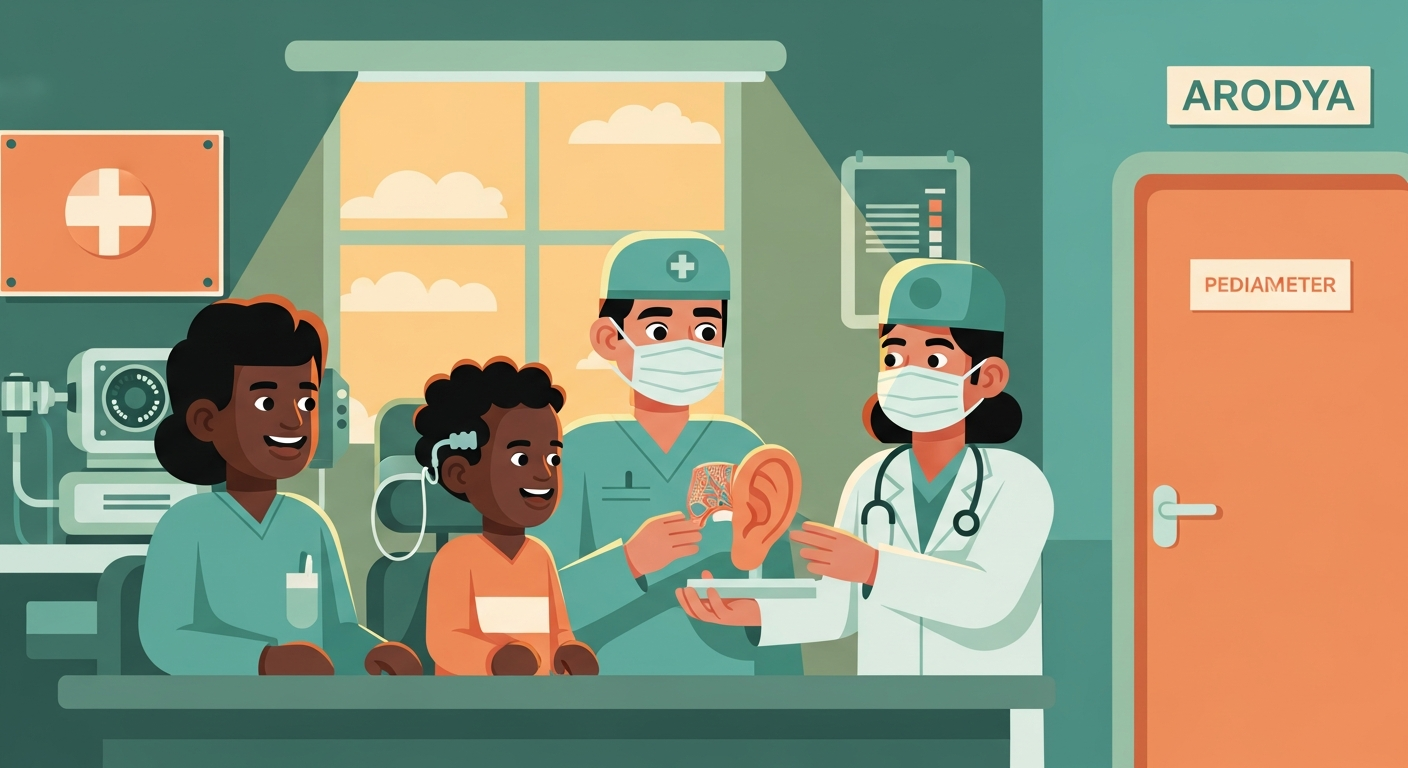
Initial activation is an emotional milestone for families. The audiologist activates the processor and adjusts the electrical stimulation levels (MAPs) so the child hears comfortably. Young children cannot report what they hear, so audiologists use behavioural observation and objective measures (ESRT — electrically evoked stapedius reflex threshold) to programme the device.
Multiple programming sessions are needed in the first months as the brain adapts to the new stimulation pattern. In India, families typically stay for 4–6 weeks post-surgery to complete the initial programming sessions and begin speech therapy.
Remote programming is now available. All three major implant brands support teleaudiology, allowing subsequent MAP adjustments via video appointment. AIIMS, Apollo, and Fortis all have teleaudiology programmes for international patients, meaning follow-up after returning to Nigeria, Kenya, or Ghana can be managed remotely — or with a local audiologist guided by the Indian team.
Speech Therapy After Cochlear Implant
For children born deaf or profoundly deaf from early infancy, hearing through a cochlear implant is a new and learned experience. Speech therapy — auditory verbal therapy specifically — is essential to translate access to sound into language development.
Indian cochlear implant centres have dedicated auditory verbal therapists. Families should plan intensive speech therapy during their India stay and commit to a structured programme after returning home. Outcomes are strongly influenced by how much time families invest in the child's listening and spoken language development in the first 12–24 months after implantation.
Children implanted before age 3 who receive intensive auditory verbal therapy typically develop spoken language skills that allow mainstream schooling. Results in older children depend on how long the child has been without hearing and the quality of rehabilitation.
Top Hospitals for Cochlear Implant in India
AIIMS Delhi is India's premier public medical institution and runs one of the country's highest-volume cochlear implant programmes. All three implant brands are available. Costs are the lowest of any major centre in India. International patients are managed through the hospital's international patient cell, though advance scheduling is essential.
Apollo Hospitals (Delhi and Chennai) are JCI-accredited and have dedicated paediatric ENT and cochlear implant teams. The international patient coordinators are experienced with African families and speak English throughout all interactions. Programming and teleaudiology follow-up is well-organised.
Fortis Memorial Research Institute, Gurugram offers a strong ENT and cochlear implant programme with excellent audiological rehabilitation services. It is well-positioned for families staying in Delhi's National Capital Region.
Amrita Institute of Medical Sciences, Kochi has a nationally recognised cochlear implant programme and is particularly accessible for families entering through South Indian airports (Kochi international airport has direct regional connections).
How Arodya Coordinates Paediatric Cochlear Implant Cases
Paediatric cases require particularly careful coordination. Arodya's team reviews the child's audiological reports and imaging before travel, identifies the most appropriate centre based on the specific case, and arranges consultation, surgical scheduling, activation appointments, and accommodation in a single coordinated plan.
For cochlear implant cases, Arodya also connects families with India-based speech-language pathologists and auditory verbal therapists who can begin working with the child from activation. Post-return, Arodya maintains the communication link between the family, the Indian audiologist, and any local audiologist.
Start the process through our intake form. Send the child's recent audiometry reports, ABR results if available, and any imaging. Our team will identify the right hospital, provide a detailed cost estimate, and outline the complete programme from pre-surgery to post-activation.
Practical Notes for Families
India's major medical cities — Delhi, Mumbai, Chennai, Bangalore — offer family accommodation options ranging from hospital guesthouses to serviced apartments. For a 6–8 week stay, a serviced apartment near the hospital is typically the most comfortable and cost-effective option.
India's climate is warm and generally comfortable for children. Hospital environments at major centres are child-friendly, with paediatric wards designed to reduce anxiety. English is spoken throughout the medical interaction at all recommended hospitals.
For a complete overview of what to expect as a first-time visitor to India for medical treatment, our guide covers the practical details families need before departure.
The hearing a cochlear implant provides cannot undo years of silence — but it opens a world that many deaf children from Africa have been waiting for. The surgery is safe, the technology is proven, and India makes it accessible.