First Time Travelling to India for Surgery: A Complete Guide for International Patients (2026)


More than 700,000 international patients travelled to India for medical treatment in 2023 — and most of them had never done anything like it before. The process of planning surgery in a foreign country can feel overwhelming, but for the vast majority of patients it follows a clear, predictable sequence that is simpler than it first appears.
This guide walks through every stage: from the moment you decide to explore treatment in India to the day your surgeon clears you to board your flight home.
TL;DR: First-time patients typically need 3–4 weeks in India for most surgical procedures. The journey runs through five stages: remote hospital assessment, Medical Visa application (5–10 days processing), arrival and pre-surgical evaluation (2–3 days), the procedure and hospital stay, and 10–14 days of post-discharge recovery before flying home. A dedicated coordinator — from the hospital or a facilitator like Arodya — handles most of the logistics, leaving you to focus on your health.
Before You Travel: Getting Your Remote Assessment and Hospital Appointment
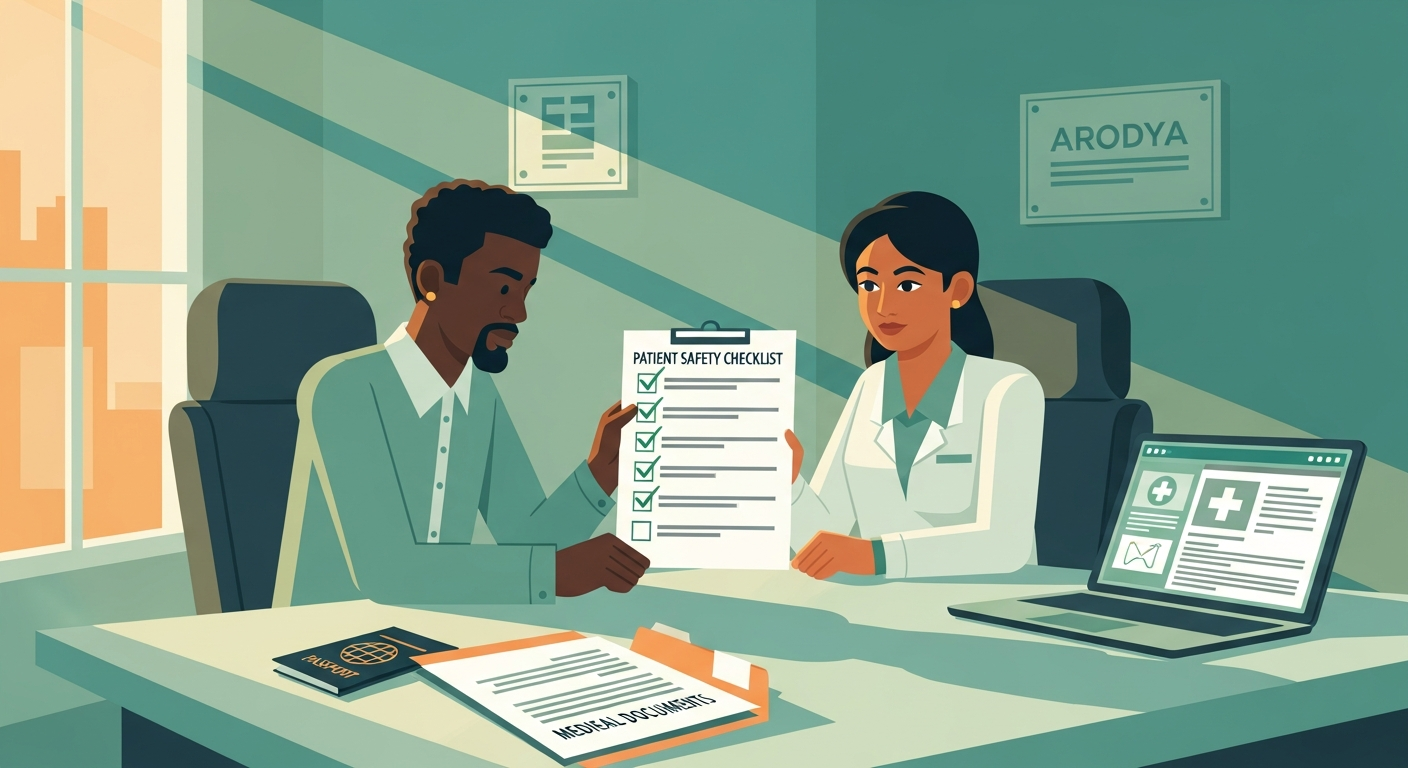
The process begins before you book any flights. India's major hospitals accept medical records digitally — you don't need to travel to India for an initial consultation.
What to send:
- All recent diagnostic reports: blood panels, imaging (CT, MRI, X-ray, PET), biopsy results
- Your current medication list with dosages
- A brief medical history covering past surgeries, chronic conditions, and allergies
- Any previous specialist letters or discharge summaries
Most hospitals' international patient departments respond within 48–72 hours with a preliminary clinical assessment, a recommended treatment plan, an estimated cost, and an appointment availability window.
Personal Experience
What Arodya patients tell us: The most common delay at this stage is not having all imaging on a CD or digital format — only having printed reports. If your diagnostic centre can export your DICOM imaging files digitally, do that. Indian specialists need to see the actual scans, not just the written report.
Once you accept a hospital's proposal, they issue a formal hospital invitation letter — a document you need to apply for your Medical Visa.
Applying for Your Indian Medical Visa
India issues a dedicated Medical Visa (M-Visa) for patients travelling for treatment. This is not the same as a tourist visa and carries specific benefits: it allows a stay of up to 60 days (extendable), allows triple entry, and permits up to two companions to travel with you on a Medical Attendant Visa (MX-Visa).
Documents required for M-Visa application:
| Document | Notes |
|---|---|
| Valid passport (6+ months validity) | Must have at least 2 blank pages |
| Hospital invitation letter | From the Indian hospital on official letterhead |
| Completed visa application form | Available at the Indian embassy or e-portal |
| Recent passport-sized photographs | As per embassy specifications |
| Medical reports / diagnosis summary | Supporting the need for treatment |
| Proof of funds | Bank statements or travel insurance covering medical costs |
| Proof of accommodation | Hotel booking or hospital guest house confirmation |
Processing typically takes 5–10 business days at most Indian embassies and consulates. Begin your application as soon as you receive the hospital invitation letter — do not wait until your travel date is confirmed.
Companions should apply simultaneously for the MX-Visa using the same hospital invitation letter.
Get your hospital invitation letter by starting your case with Arodya at.
What to Pack and Prepare Before You Fly
Careful preparation before departure reduces unnecessary stress and delays once you arrive.
Essential medical documents (physical copies + digital backup):
- Passport and Medical Visa
- All diagnostic reports in English (translated if originals are in another language)
- Complete medication list with generic drug names (brand names vary internationally)
- Sufficient supply of current medications to cover your full India stay plus 1 week buffer
- Any implant cards (pacemaker, joint replacement, stent)
Practical items:
- Universal power adapter (India uses Type D/M plugs)
- Comfortable, loose-fitting clothing for hospital stays
- A small notebook or notes app for tracking questions and appointments
- Your companion's contact details registered with the hospital
Financial arrangements:
Most hospitals require a 50–100% advance payment before major procedures. International wire transfers, credit cards (Visa/Mastercard), and demand drafts are accepted. Carry some Indian rupees (INR) in cash for incidental expenses — your bank card will work at major ATMs in hospital districts.
Inform your home bank of your travel dates so your card isn't blocked for foreign transactions.
Arriving in India: Airport to Hospital
India's three main international medical tourism gateways are Delhi's Indira Gandhi International Airport (IGI), Mumbai's Chhatrapati Shivaji Maharaj International Airport (CSIA), and Chennai International Airport (MAA). All three have dedicated international arrival terminals with assistance services.
What happens when you land:
Your hospital or facilitator should arrange airport pickup. Major hospitals provide dedicated medical tourist pickup with a coordinator who holds a name board at the arrivals gate. This person handles:
- Assisting you through customs and exit
- Transfer to hotel or directly to the hospital
- Confirming your appointment schedule for the following days
If you haven't arranged pickup, authorised medical transport services operate from all three airports, and major hospital international desks can arrange transfers even on short notice.
At hotel check-in (if not going directly to hospital):
Rest after the flight. Long-haul travel from Africa or the Middle East involves 6–12 hours in the air, often with a connection. Most pre-surgical evaluations are scheduled for the morning after arrival — your body needs 12–24 hours to rebalance before baseline bloodwork is taken.
Arodya Insight
Your First Days at the Hospital: Pre-Surgical Evaluation
Pre-surgical evaluation typically runs 2–3 days and involves a structured series of assessments before your surgical team makes a final go/no-go decision.
Standard pre-operative workup:
| Test | Purpose |
|---|---|
| Complete blood count (CBC) | Baseline health, infection, anaemia |
| Coagulation profile (PT/INR) | Bleeding risk assessment |
| Kidney and liver function tests | Anaesthesia safety |
| Fasting blood glucose / HbA1c | Diabetes assessment |
| ECG and echocardiogram | Cardiac baseline |
| Chest X-ray | Pulmonary status |
| Procedure-specific imaging | Confirm surgical plan |
| Anaesthesia consultation | Assess airway, risk classification |
If you have brought recent reports from home (within 3–6 months), some tests may be accepted without repeating — ask your doctor which can be waived. This can save $200–$500 in repeat diagnostic costs.
At the end of the evaluation period, your surgical team holds a briefing to explain the final surgical plan, risks, and recovery expectations. This is your opportunity to ask every question you have — bring your notebook.
During Your Hospital Stay
The hospital experience in India's major international-patient-focused hospitals is notably patient-centred. Here is what to expect:
Room options:
Private rooms are standard for international patients and typically include a bed for one companion. Most major hospitals allow the companion to stay in-room throughout the post-surgical period.
Meals:
Hospital dietitians provide customised meal plans. Inform the nursing team of dietary restrictions, religious food requirements, and allergies on admission day. Most hospitals offer halal, vegetarian, and regional African cuisine options on request.
Communication:
English is the working language in international patient departments. For Arabic, French, Swahili, or other languages, interpreters are available at most major hospitals — request one in advance when confirming your appointment.
International desk support:
Your hospital's international patient coordinator is your primary point of contact throughout your stay. They handle billing queries, appointment scheduling, family updates, telemedicine requests, and post-discharge planning. Save their number on your phone on day one.
The Recovery Period: Why You Must Not Rush Home
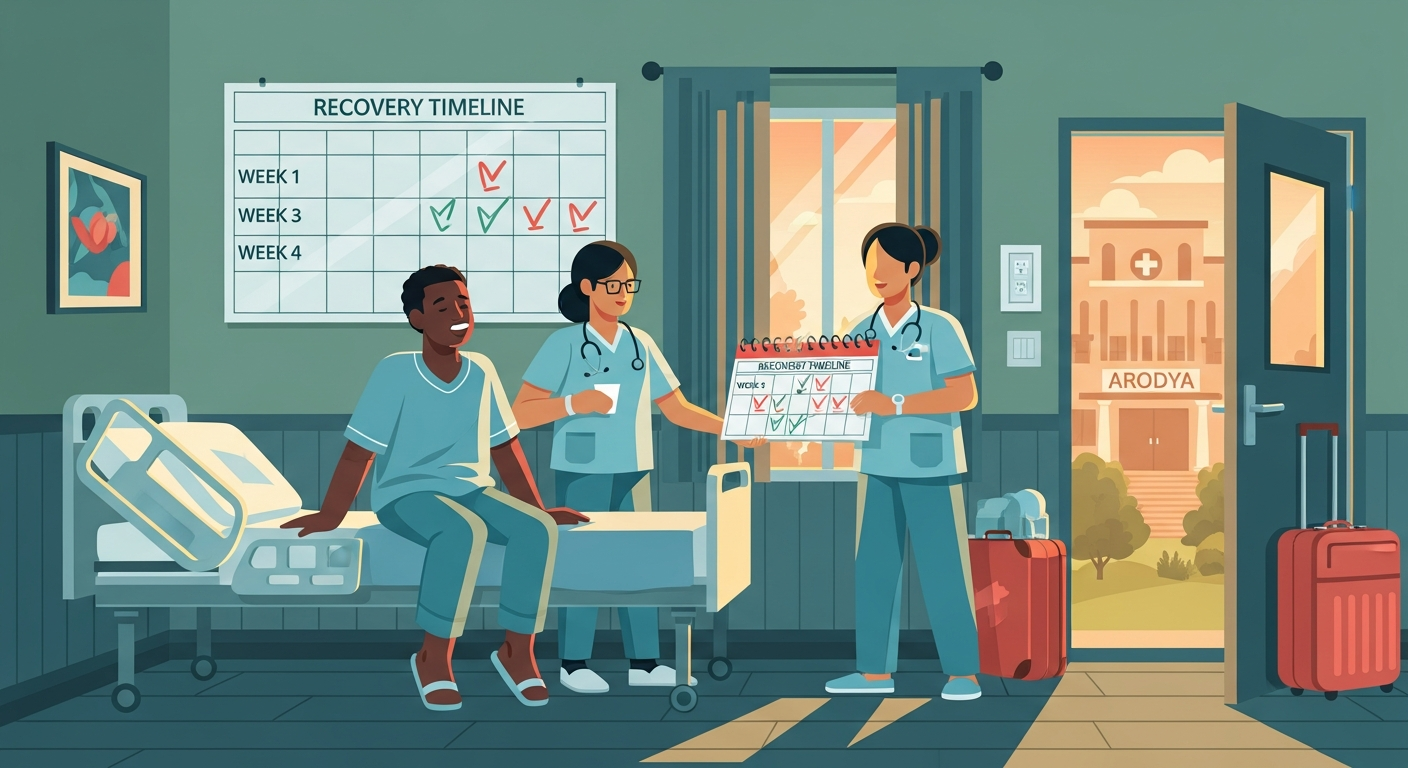
Post-discharge recovery is the stage first-time patients most often underestimate. Surgeons require a mandatory recovery period in India before clearing you for a long-haul flight — for good medical reason.
Air travel at cabin pressure following major surgery carries risks: deep vein thrombosis (DVT), surgical wound stress, and medical emergencies where diverting the aircraft is the only option. Your surgeon sets a minimum post-discharge stay based on your procedure:
| Procedure Type | Minimum Post-Discharge Stay Before Flying |
|---|---|
| Cardiac surgery (CABG, valve repair) | 14 days |
| Major abdominal surgery | 10–14 days |
| Joint replacement (hip, knee) | 10–12 days |
| Spinal surgery | 10–14 days |
| Laparoscopic procedures | 7–10 days |
| Chemotherapy (first cycle) | 3–5 days |
During this recovery period, you will have follow-up appointments for wound checks, suture removal, physiotherapy sessions, and a final clearance assessment. Book accommodation close to the hospital — most hospitals maintain partnerships with guest houses and hotels within 2–5 km, often at discounted rates for their international patients.
For a detailed breakdown of recovery timelines, read our guide on how long you should stay in India after major surgery.
Returning Home and Continuity of Care
Your hospital discharge package is as important as the procedure itself. Before leaving the hospital, confirm you have received:
Discharge documentation:
- Full discharge summary (clinical notes, procedure details, anaesthesia record)
- Medication list with dosages and duration — in English, with generic drug names
- Follow-up appointment schedule
- Wound care instructions
- Physiotherapy or rehabilitation protocol
- Your surgeon's email or telemedicine contact for follow-up
Telemedicine follow-up:
All major Indian hospitals offer virtual consultations for international patients post-discharge. Most include 3–6 months of telemedicine follow-up at no additional charge. This allows your Indian specialist to review your recovery photos, bloodwork, and imaging alongside your local doctor.
Sharing your records with your home doctor:
Take the discharge summary to your local physician within one week of returning home. The summary contains everything they need to manage your ongoing care and medication. Indian hospitals use internationally standardised documentation — your local doctor will be able to read and act on it directly.