How to Verify If an Indian Hospital is Accredited: JCI and NABH Explained Simply 2026


TL;DR: JCI (Joint Commission International) and NABH (National Accreditation Board for Hospitals) are India's two key hospital quality certifications. JCI is the gold standard for international patients — 61 Indian hospitals hold it as of 2026. To verify: check the JCI directory at jointcommissioninternational.org or call the hospital's international desk for their certificate number.
What Is Hospital Accreditation and Why Does It Matter?
As of 2026, 61 Indian hospitals hold JCI accreditation — the same certification that governs leading US and European hospitals. (Joint Commission International, 2026) For international patients considering $10,000–50,000 surgical procedures, accreditation is the baseline check that separates verified facilities from unverified ones. It doesn't guarantee perfect outcomes, but it does guarantee independently-verified safety protocols.
Citation capsule: JCI accreditation requires a 2–3 day physical survey by independent assessors covering surgical safety, infection control, staff credentials, equipment standards, and outcome tracking. Hospitals pay $50,000–100,000+ for accreditation and maintain it through 3-year recertification cycles. A hospital choosing that investment is demonstrating institutional commitment to quality. (Joint Commission International, 2026)
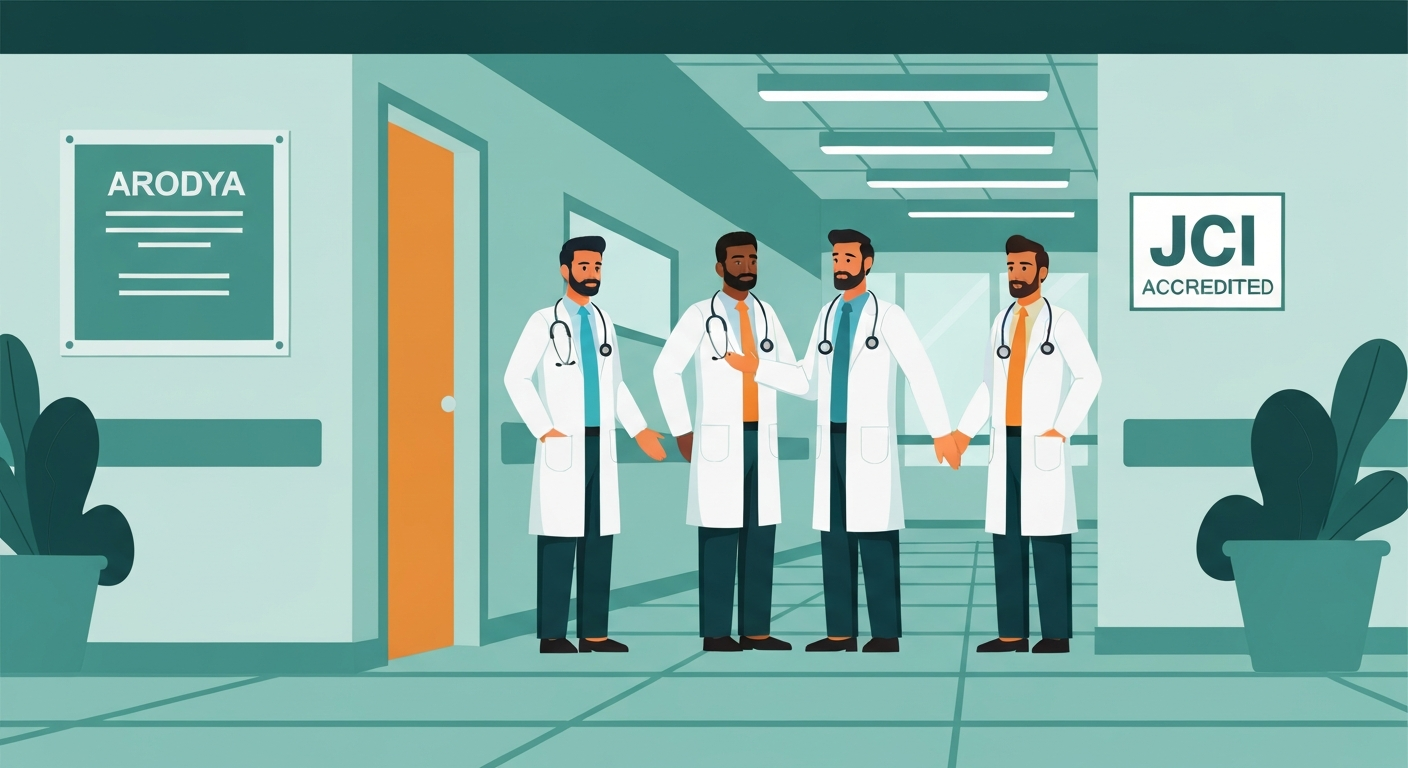
What Is JCI Accreditation?
JCI (Joint Commission International) is the global standard for hospital accreditation. It was established by the Joint Commission — the same US body that accredits American hospitals — and applies identical standards internationally. When a hospital holds JCI, it has passed the same scrutiny as leading US and UK facilities.
What JCI Verifies
JCI surveyors assess six core areas during their physical inspection:
- Patient safety — infection prevention, medication error protocols, correct-site surgery verification
- Medical staff credentials — surgeons' training records, specialist certifications, ongoing education
- Equipment and facility standards — ICU equipment, sterilization, building emergency systems
- Infection control — hand hygiene protocols, antibiotic stewardship, isolation procedures
- Patient communication — informed consent, patient rights, privacy protection
- Outcome tracking — mortality rates, complication tracking, patient satisfaction measurement
How the JCI Process Works
A hospital must apply, submit extensive documentation, then host a 2–3 day physical survey. Surveyors interview staff and patients, review medical records, and observe surgical procedures. Accreditation is valid for 3 years. Hospitals must recertify, ensuring ongoing compliance rather than a one-time snapshot.
Top Indian Hospitals Holding JCI Accreditation
- Apollo Hospitals (Delhi, Mumbai, Chennai, Bangalore)
- Medanta — The Medicity (Gurugram)
- Fortis Escorts Heart Institute (Delhi)
- Max Healthcare (select campuses)
- Narayana Health (select centres)
- Artemis Hospital (Gurugram)
What Is NABH Accreditation?
NABH (National Accreditation Board for Hospitals and Healthcare Providers) is India's national hospital quality standard, administered by the Quality Council of India. It applies the same core principles as JCI but is adapted for Indian regulatory requirements and operational context.
NABH is the baseline expectation for any serious private hospital in India. Most major hospitals hold it. For international patients, NABH is acceptable when the hospital is a well-established name with a strong reputation. JCI is preferred because international insurers and embassies recognise it directly.
JCI vs. NABH: Direct Comparison
| Aspect | JCI | NABH |
|---|---|---|
| International recognition | Highest globally | India only |
| Survey rigour | Very strict | Strict, India-adapted |
| Cost to hospital | $50,000–100,000+ | Lower |
| For international patients | Preferred | Acceptable |
| Verification method | jointcommissioninternational.org | nabh.co |
What to require: JCI + NABH (ideal), JCI alone (excellent), NABH alone from a well-known hospital (acceptable), neither (avoid).
How Do You Verify a Hospital's Accreditation?
Arodya Insight
Method 1: JCI Online Directory
Go to jointcommissioninternational.org → search "Accredited Organizations" → select India → search by hospital name. The result shows accreditation status, grant date, and expiry date. If the hospital doesn't appear, they are not JCI-accredited regardless of what their website claims.
Method 2: NABH Directory
Go to nabh.co → use the hospital search function → search by name and state. Accreditation status, issue date, and next renewal date are listed publicly.
Method 3: Direct Hospital Contact
Email the hospital's international patient department: "Please provide your current JCI or NABH accreditation certificate." A legitimate, accredited hospital responds immediately with a PDF certificate. Slow responses, vague answers, or unwillingness to provide documentation are red flags.
What Does Accreditation Guarantee — and What Doesn't It Cover?
Accreditation guarantees:
- Hospital meets independently-verified safety standards
- Surgical teams are credentialled and trained
- Equipment meets international specifications
- Infection control protocols are in place
- Patient records are properly maintained
- Hospital tracks outcomes and complications
Accreditation does not guarantee:
- Perfect surgical outcomes (no hospital can)
- Zero complications
- The individual surgeon's experience level
- Competitive pricing
- Fast appointment availability
This distinction matters. Accreditation confirms the environment is safe. The surgeon's individual case volume and subspecialty experience determines the outcome. A JCI hospital with a low-volume surgeon is inferior to a JCI hospital with a high-volume specialist.
What Other Quality Indicators Should You Check?
Accreditation is the baseline, not the complete picture. After confirming accreditation, verify:
Published outcome data: Does the hospital publish mortality and complication rates by procedure? Transparency is a signal of confidence. Narayana Health publishes outcome data publicly. Apollo and Medanta report annually.
Surgeon case volume: Ask specifically how many cases of your procedure the assigned surgeon performs annually. 600+ cases/year is strong. Below 200 cases/year warrants further questions.
Hospital age and track record: A hospital established for 20+ years has a verifiable record. A hospital opened in the past 3 years has limited public outcome history.
International patient volume: Hospitals regularly treating international patients have developed the coordination, language support, and documentation systems that make the process smoother. Ask how many international patients they treated last year.
Red Flags: When to Avoid a Hospital
- No JCI or NABH accreditation (the most serious flag)
- Accreditation certificate more than 3 years old without renewal
- Website with no information about doctor credentials or outcomes
- Quotes significantly lower than comparable accredited hospitals
- Refuses to provide accreditation documentation on request
- No dedicated international patient department
- No clear process for follow-up care after discharge