Hair Transplant in India for African Patients: FUE, Afro Hair & Costs 2026

Hair loss affects millions of men and women across Africa, with consequences that extend well beyond the physical. Receding hairlines, thinning crowns, and bald patches diminish confidence, affect professional self-presentation, and carry social weight in cultures where appearance matters deeply. India's hair restoration industry — sophisticated, experienced, and dramatically affordable — is changing the equation for African patients who previously considered hair transplant surgery financially out of reach.
Understanding Hair Loss in African Patients
Hair loss (alopecia) has multiple causes, and distinguishing between them is the first step in planning effective treatment.
Androgenetic alopecia (male pattern baldness or female pattern hair loss) is the most common cause, driven by genetic sensitivity of hair follicles to dihydrotestosterone (DHT). It follows predictable patterns — receding temples and crown thinning in men, diffuse crown thinning in women. This is the primary condition addressed by hair transplant surgery.
Traction alopecia is particularly relevant in the African context. Repeated tension on hair follicles from tight braids, weaves, extensions, and relaxers causes follicle damage and permanent hair loss, most commonly at the temples and hairline. Hair transplant surgery can restore these areas, though the causative styling practices must be modified to protect transplanted follicles.
Central centrifugal cicatricial alopecia (CCCA) is a form of scarring alopecia that predominantly affects women of African descent, beginning at the crown and spreading centrifugally. It requires specialist trichological assessment before hair transplant consideration.
Alopecia areata is autoimmune and causes patchy hair loss. It is not typically addressed by hair transplant surgery but may respond to immunological treatments available in India.
Understanding which type of hair loss is present — through a trichologist consultation and potentially a scalp biopsy — determines whether hair transplant surgery is appropriate and likely to succeed.
FUE: The Preferred Technique for African Hair
Follicular Unit Extraction (FUE) has become the dominant hair transplant technique globally and is particularly well-suited to African patients.
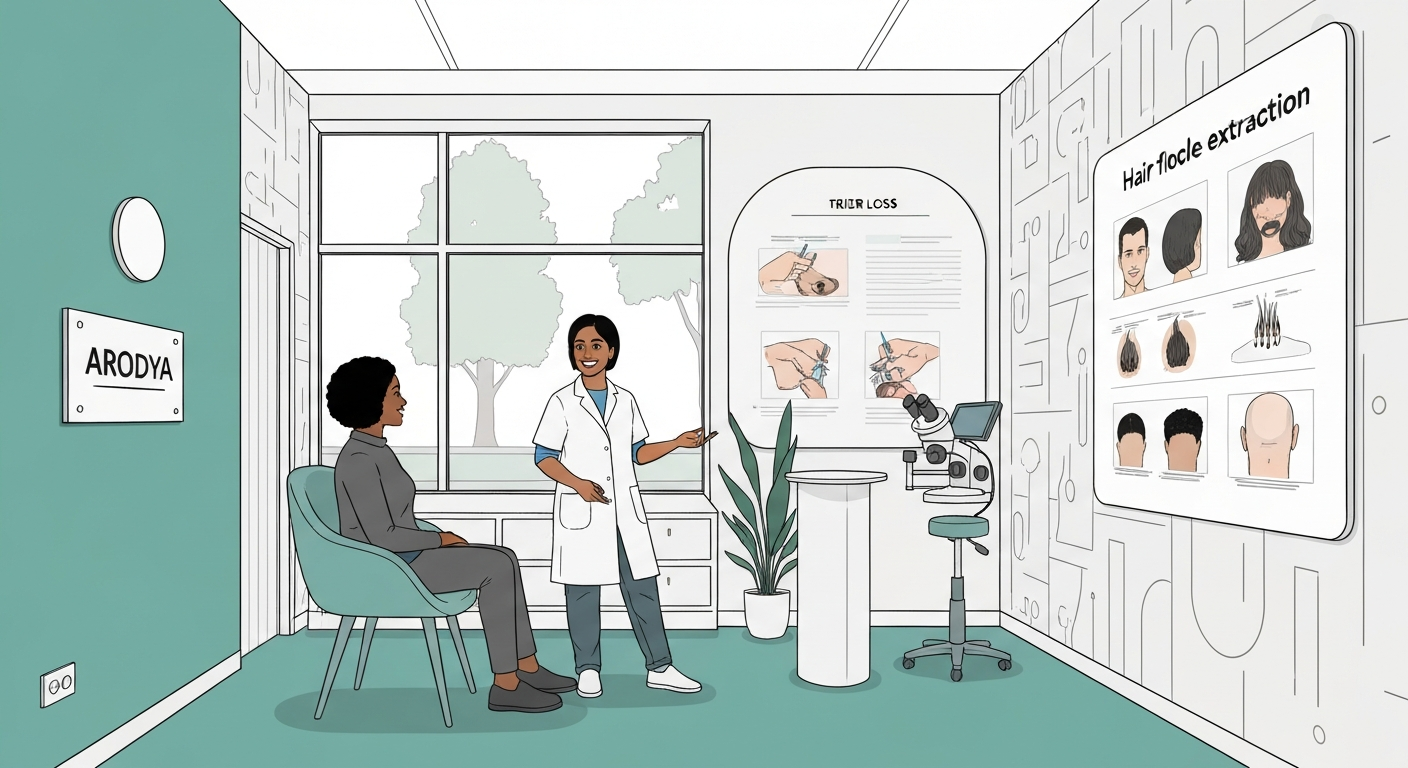
In FUE, individual follicular units (groups of 1–4 hair follicles) are extracted directly from the donor area (typically the back and sides of the scalp) using a circular punch instrument 0.7–1.0mm in diameter. The extracted grafts are stored in a preservation solution and transplanted into recipient sites created at the desired hairline and density.
The African hair challenge: Hair follicles in African-textured (Afro or coily) hair follow a curved path beneath the scalp surface. Standard FUE punches used for straight Asian or European hair will transect (cut) these curved follicles if used incorrectly, destroying grafts before transplantation. Experienced surgeons performing FUE on African patients use:
- Smaller punch diameters (0.8–0.9mm vs 1.0mm for straight hair)
- Angled extraction approach aligned with follicle curve
- Controlled rotation or oscillation rather than simple punching
- Enhanced magnification to visualise follicle direction
India's leading trichology and hair transplant centres have refined these techniques through high volumes of patients with diverse hair types. African patients need to specifically confirm that their chosen clinic has experience with Afro-textured hair — not all clinics do, even in India.
FUT: When Strip Harvesting Makes Sense
Follicular Unit Transplantation (FUT) — also called the strip method — involves surgically removing a strip of scalp from the donor area, then dissecting individual follicular units under magnification before transplanting them.
Advantages of FUT:
- Higher graft yield per session (3,000–4,000+ grafts vs 2,000–3,000 for FUE)
- Slightly higher graft survival rates due to controlled dissection
- Suitable for patients needing very high graft counts
Disadvantages of FUT:
- Leaves a linear scar at the donor site (concealed by longer hair, but visible if hair is worn very short)
- Longer recovery period
- More post-operative discomfort
For African patients with Afro-textured hair who prefer to wear their hair very short or shaved, FUT's linear scar may be visible. FUE's scattered circular scars heal to near-invisible pink dots. Most African hair transplant patients choose FUE for this reason.
PRP Therapy: Enhancing Results and Managing Early Hair Loss
Platelet-Rich Plasma (PRP) therapy uses growth factors from the patient's own blood to stimulate follicle activity. Blood is drawn, centrifuged to concentrate platelets, and injected into the scalp.
Applications in hair loss:
- Standalone treatment for early androgenetic alopecia: PRP slows progression and can stimulate miniaturised follicles to produce thicker hair. Results are modest but meaningful. 3–4 sessions at monthly intervals, then quarterly maintenance.
- Combined with FUE transplant: PRP is injected into the transplant area during or after surgery to improve graft survival and accelerate healing. Evidence supports measurably better density outcomes with combined transplant + PRP.
- Treatment for traction alopecia (before transplant): Stabilising the scalp environment with PRP before transplant improves outcomes in previously damaged areas.
PRP sessions cost $150–300 each in India. A standard 3-session course costs $450–900, compared to $1,000–2,000+ per session in the UK.
Cost Comparison: India vs UK vs USA vs Turkey
| Service | India (USD) | UK (GBP) | USA (USD) | Turkey (USD) |
|---|---|---|---|---|
| 2,000–2,500 grafts FUE | 1,500–2,500 | 5,000–8,000 | 8,000–12,000 | 1,500–3,000 |
| 3,000–3,500 grafts FUE | 2,500–3,500 | 7,000–12,000 | 12,000–18,000 | 2,500–4,000 |
| 4,000+ grafts FUE | 3,500–5,000 | 10,000–16,000 | 15,000–25,000 | 3,500–5,500 |
| PRP session | 150–300 | 500–800 | 600–1,000 | 150–300 |
| Trichologist consultation | 50–100 | 200–400 | 300–500 | 80–150 |
India and Turkey are broadly competitive on price, with India's advantage being the quality of accompanying medical care and the broader hospital infrastructure for patients combining hair transplant with other procedures.
Top Hair Transplant Cities in India
Delhi (NCR): India's highest concentration of hair transplant clinics, including several with specific African patient experience. Delhi's international airport connectivity makes it the most accessible entry point for African patients.
Mumbai: Several prestigious dermatology and trichology centres. Access to specialist dermatologists for complex cases including CCCA and scarring alopecia.
Bangalore and Chennai: Growing hair restoration centres with strong clinical standards and lower costs than Delhi or Mumbai.
What to Expect: The Process from Consultation to Results
Pre-surgery consultation (Day 1): Trichologist assessment of donor area density, scalp health, recipient area mapping, hairline design discussion, and photography. Graft count is estimated. Scalp is examined under dermoscopy to assess follicle health.
Surgery day (Day 2 or 3): Oral sedation or local anaesthesia. Donor site shaving if needed (FUE). Extraction phase: 4–6 hours depending on graft count. Slitting phase: recipient sites created by surgeon. Placement phase: grafts placed by technician team under surgeon supervision. Total duration: 6–10 hours. Mild discomfort, no significant pain.
Post-surgery days (Days 3–5): Gentle hair washing technique taught. Protective cap worn over transplanted area. Mild swelling of forehead (resolves in 3–5 days). Activity restrictions (no gym, bending, sweating for 10 days).
Follow-up (Day 7): Donor area check, any necessary cleaning, photography.
Results timeline:
- 2–4 weeks: Transplanted hairs shed (shock loss — normal and expected)
- 3–4 months: New hair growth begins
- 8–12 months: Significant density visible
- 12–18 months: Full, mature result
The transplanted hair follicles are permanent — they are DHT-resistant and will not follow the same loss pattern as the original hair in those areas.
Starting Your Hair Restoration Journey
For African patients considering hair transplant surgery in India, the assessment begins with photographs. Send front, top, and back scalp photographs along with a description of your hair loss history (when it began, family history, previous treatments tried) to Arodya's coordination team. Review the medical visa process for India before your trip, then submit your assessment here.
Our trichology coordinator will review your photographs and connect you with the most appropriate hair transplant specialist — one with documented experience in African hair types. A detailed quote, surgeon profile, clinic details, and logistics guidance will be provided within 24 hours.
Hair loss does not have to be permanent. India's trichology expertise is offering African patients a genuine path to natural, lasting hair restoration at a price that makes the journey worthwhile.