Total & Reverse Shoulder Replacement in India: Cost & Guide for International Patients 2026

Total & Reverse Shoulder Replacement in India: Cost & Guide for International Patients 2026
The shoulder is the most mobile joint in the human body — and when it fails, the consequences for daily life are profound. Dressing, reaching overhead, sleeping, and even eating become painful or impossible. Shoulder arthritis and rotator cuff arthropathy are conditions that rob people of independence in a way that affects every waking hour.
For international patients whose shoulders have reached the point where surgery is the only path to a functional life, India offers a compelling combination: surgeons who have performed thousands of shoulder replacements, implants from the world's leading orthopaedic companies, and costs that are 70-80% lower than the USA or UK.
This guide explains the two main types of shoulder replacement surgery, who they are appropriate for, what recovery looks like, and how to access this care in India.
Understanding Shoulder Replacement: Two Very Different Operations
The term "shoulder replacement" covers two distinctly different procedures with different indications, techniques, and outcomes. Understanding the difference is essential for any patient evaluating their options.
Total (Anatomic) Shoulder Replacement
In total shoulder replacement (also called total shoulder arthroplasty or TSA), the damaged ball-and-socket joint is replaced with prosthetic components that replicate normal anatomy. A metal ball (humeral head component) replaces the natural ball of the humerus, and a plastic glenoid component replaces the socket. The shoulder functions through the same muscle mechanics as the natural joint.
Who needs anatomic total shoulder replacement:
- Severe glenohumeral osteoarthritis with an intact rotator cuff
- Inflammatory arthritis (rheumatoid, psoriatic)
- Post-traumatic arthritis following shoulder fractures
- Avascular necrosis of the humeral head with intact cuff
The critical requirement is an intact, functional rotator cuff. If the rotator cuff is torn, anatomic replacement typically fails — the torn tendons cannot stabilise the prosthetic ball on the socket.
Reverse Shoulder Replacement
Reverse shoulder replacement (reverse shoulder arthroplasty or RSA) was developed to solve exactly the problem that made anatomic replacement inappropriate for many of the patients who most needed it: massive rotator cuff tears. In reverse replacement, the ball and socket are literally reversed — a metal ball is fixed to the glenoid (socket side), and a plastic cup is fixed to the humerus (ball side).
This inverted geometry means the shoulder no longer relies on the rotator cuff for stability and function. Instead, the deltoid muscle — which is intact even when the rotator cuff is destroyed — becomes the primary mover. The result is a shoulder that works, functions, and is pain-free, even without a functioning rotator cuff.
Who needs reverse shoulder replacement:
- Massive, irreparable rotator cuff tears with secondary arthritis (cuff tear arthropathy)
- Failed previous anatomic shoulder replacement (revision)
- Complex proximal humerus fractures in elderly patients
- Certain tumour resections
- Some cases of severe inflammatory arthritis
Reverse shoulder replacement was considered experimental as recently as the 1990s. Today it is the standard of care for cuff tear arthropathy and represents the majority of shoulder replacement procedures at high-volume centres.
Shoulder Replacement Costs: India vs the World
| Procedure | USA | UK | India |
|---|---|---|---|
| Total (anatomic) shoulder replacement | $35,000–50,000 | £20,000–35,000 | $8,000–11,000 |
| Reverse shoulder replacement | $40,000–60,000 | £25,000–40,000 | $10,000–13,000 |
| Revision shoulder replacement | $50,000–80,000 | £30,000–50,000 | $12,000–18,000 |
Indian costs include implants, surgeon fees, anaesthesia, operating theatre, hospital stay (typically 3-5 days), and immediate post-operative physiotherapy. They do not include international flights or accommodation.
On implants: India uses the same implant systems as Western hospitals. Depuy Synthes (Johnson & Johnson), Stryker, Zimmer Biomet, and Smith & Nephew shoulder systems are all used by Indian orthopaedic surgeons. The cost difference does not reflect an implant quality difference — it reflects lower operating costs, lower specialist fees, and lower overhead in India's hospital market.
What the Procedure Involves
Pre-operative assessment: CT scan and MRI of the shoulder, full blood workup, cardiac assessment if needed. Arodya can facilitate pre-operative imaging in the patient's home country so results are available before travel.
Anaesthesia: General anaesthesia plus regional nerve block (interscalene block) for post-operative pain control. The block typically provides 18-24 hours of numbness and pain relief after surgery.
Surgery duration: Approximately 90-150 minutes for primary procedures. Complex revision cases may take longer.
Hospital stay: 3-5 days for primary procedures. Discharge requires comfortable movement, adequate pain control on oral medications, and wound healing.
Recovery: The Critical Rehabilitation Phase
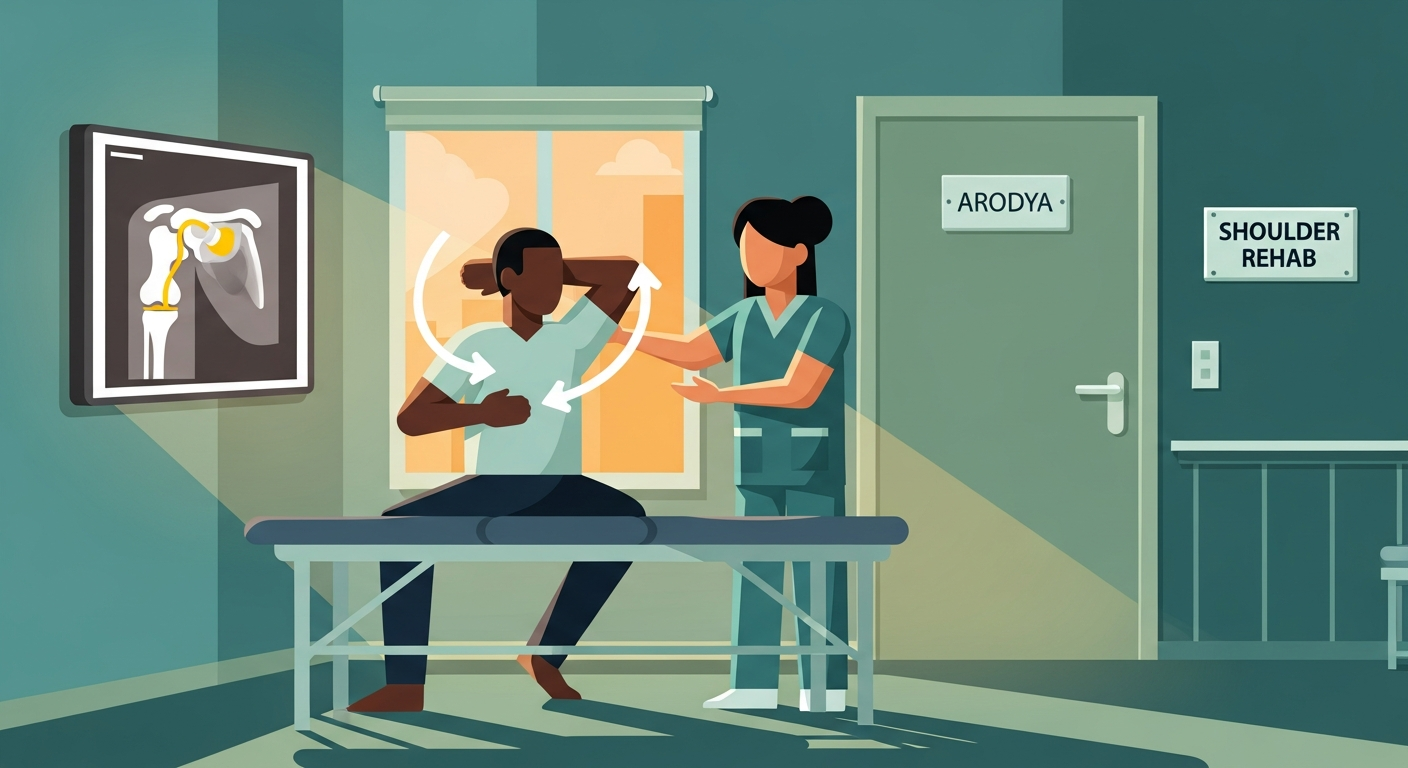
Recovery from shoulder replacement is as much about physiotherapy as it is about surgery. The rehabilitation programme is structured in phases:
Phase 1 (0-6 weeks): Protection
The arm is kept in a sling. Gentle pendulum exercises and elbow/wrist movements begin immediately. Active shoulder movement is restricted while the soft tissues heal around the implants.
Phase 2 (6-12 weeks): Progressive range of motion
The sling is progressively discontinued. Active-assisted exercises begin. Range of motion expands progressively.
Phase 3 (3-6 months): Strengthening
Resistance exercises build deltoid and remaining rotator cuff strength. Function returns for daily activities.
Phase 4 (6-12 months): Return to full activity
Most patients achieve their functional plateau. Reverse shoulder replacement patients typically progress faster than anatomic replacement patients in the early phases.
For international patients: Arodya coordinates physiotherapy follow-up in your home country after you return. We provide your home physiotherapist with the detailed rehabilitation protocol from your Indian surgeon.
Top Shoulder Surgeons and Hospitals in India
India's shoulder replacement expertise is concentrated in major cities:
Delhi: Medanta — The Medicity, Fortis Hospital Gurugram, Apollo Hospitals Delhi, Max Super Speciality Hospital. Delhi's orthopaedic departments have surgeons who trained in the USA, UK, and Australia and bring international-level shoulder arthroplasty expertise.
Mumbai: Kokilaben Dhirubhai Ambani Hospital, Hinduja Hospital, Lilavati Hospital. Mumbai has a strong upper limb surgery tradition.
Chennai: Apollo Hospitals Chennai, Fortis Malar, Kauvery Hospital. Chennai is a major hub for medical tourism and has strong shoulder specialist capability.
Hyderabad: Yashoda Hospitals, KIMS Hospitals, Asian Institute of Gastroenterology (which also has an orthopaedic programme).
When Arodya matches patients to shoulder surgeons, we look specifically at the surgeon's fellowship training, case volume (shoulder replacement surgeons should perform at least 50 shoulder arthroplasties annually), implant expertise, and international patient experience.
The Patient Journey: From Diagnosis to Recovery
Step 1: Share your imaging — X-rays, MRI, CT scan, and clinical notes with Arodya. We share these with matched surgeons for evaluation.
Step 2: Surgeon's opinion — You receive a written treatment recommendation including which type of replacement is recommended and why.
Step 3: Hospital cost estimate — A detailed cost breakdown including implant choices.
Step 4: Travel planning — Arodya assists with medical visa documentation, flight timing (we recommend 2-3 days in India before surgery for recovery from travel), and accommodation near the hospital.
Step 5: Surgery and recovery — 3-5 day hospital stay, then 7-10 days in India recovering in your accommodation with physiotherapy support.
Step 6: Return home — With full surgical records, rehabilitation protocol, and telemedicine follow-up arrangements.
Who Should Consider Shoulder Replacement in India?
Shoulder replacement in India is most appropriate for patients who:
- Have been told they need shoulder replacement by their doctor at home but cannot access or afford the procedure
- Have been on a waiting list for more than 3-6 months in a public health system
- Face prohibitive out-of-pocket costs in their country's private sector
- Are prepared to travel for 2-3 weeks for surgery and initial recovery
It is not appropriate for patients with active shoulder infection, certain neurological conditions, or severe medical co-morbidities that make major surgery high-risk.
If your shoulder pain is limiting your life, and conservative treatment has been exhausted, India's orthopaedic teams can help. Start your Arodya consultation today — share your imaging and let us connect you with India's leading shoulder surgeons.