PCOS Treatment in India for African Women: Hormonal & Fertility Guide 2026
PCOS Treatment in India for African Women: Hormonal & Fertility Guide 2026
Polycystic ovary syndrome (PCOS) is the most common hormonal disorder affecting women of reproductive age worldwide, and Africa is no exception. Studies from Nigeria, Kenya, South Africa, and Egypt suggest PCOS prevalence of 15–22% in African women — yet the condition remains dramatically underdiagnosed across the continent, with many women spending years experiencing irregular periods, unexplained weight gain, acne, and infertility without ever receiving a clear diagnosis.
India's endocrinology and gynaecology teams have developed sophisticated, evidence-based PCOS management programmes that address the full complexity of the condition — hormonal balance, metabolic health, fertility, and psychological wellbeing — within a single coordinated team. For African women who have struggled with PCOS symptoms or fertility challenges, India offers comprehensive care at accessible cost with genuine expertise.
Key fact: PCOS is the most common cause of anovulatory infertility worldwide. Letrozole-based ovulation induction in India achieves ovulation in 75–80% of PCOS patients per cycle. IVF for PCOS-related infertility costs $3,500–6,000 per cycle in India.
What Is PCOS?
Polycystic ovary syndrome is a hormonal condition characterised by a combination of three features (any two of three required for diagnosis under Rotterdam criteria):
- Irregular or absent ovulation: Fewer than eight menstrual cycles per year, very unpredictable cycles, or complete absence of periods (amenorrhoea)
- Biochemical or clinical androgen excess: Elevated testosterone or DHEAS on blood tests, or clinical signs of androgen excess — acne, oily skin, excess facial or body hair (hirsutism), or scalp hair thinning (female-pattern hair loss)
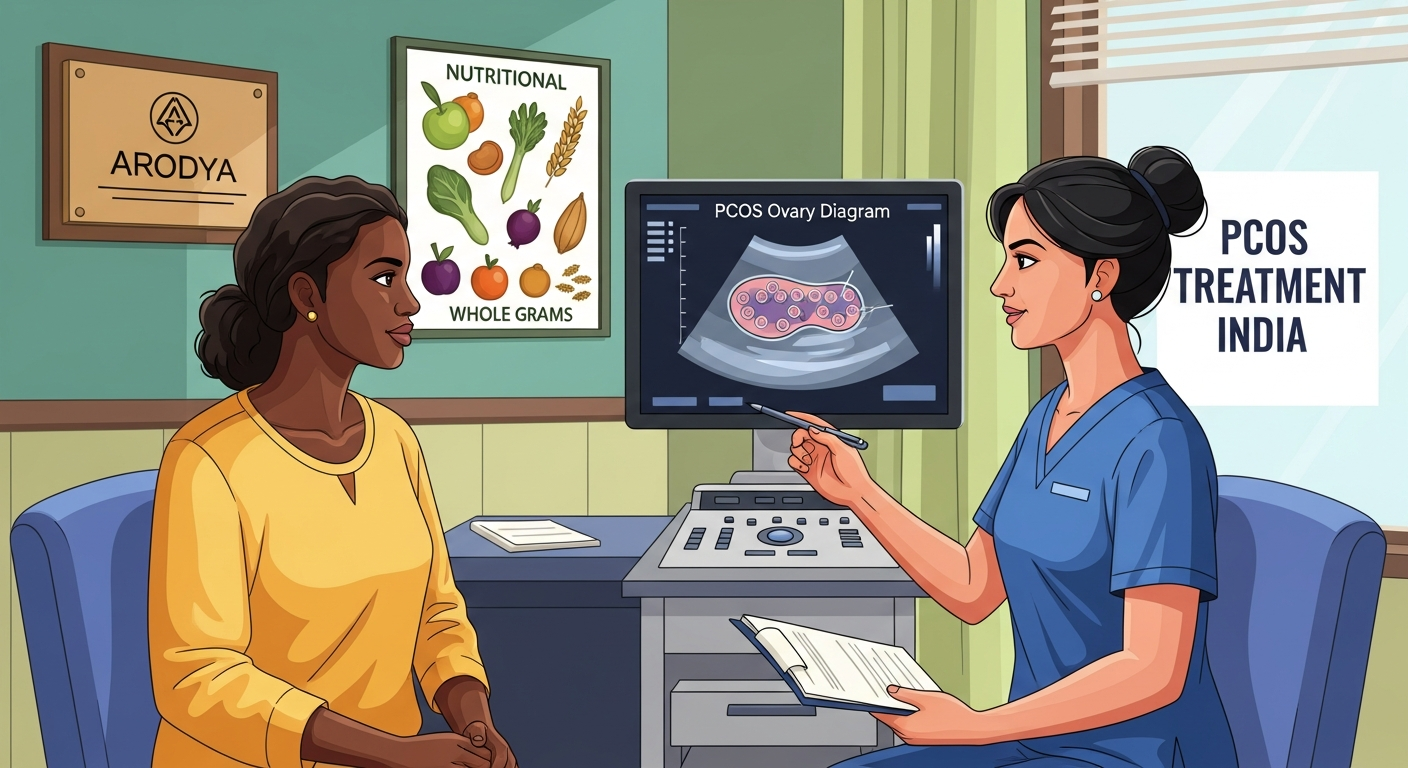
- Polycystic ovaries on ultrasound: Twelve or more small follicles (cysts) visible in each ovary, or enlarged ovarian volume
PCOS is a diagnosis of exclusion — thyroid dysfunction, elevated prolactin, adrenal disorders, and other conditions that mimic PCOS must be ruled out first.
Why Is PCOS Underdiagnosed in Africa?
Several factors contribute to PCOS underdiagnosis across Africa:
Limited access to gynaecological ultrasound: Polycystic ovary appearance on ultrasound requires transvaginal or transabdominal ultrasound with appropriate equipment and expertise. In many African clinics, this is not routinely available.
Normalisation of irregular cycles: Many African women — and their healthcare providers — accept irregular periods as normal, delaying investigation.
Limited hormonal testing availability: A PCOS workup requires measuring LH, FSH, testosterone, DHEAS, prolactin, thyroid function, AMH, and fasting insulin. These panels are not available everywhere.
Cultural taboos around infertility: In contexts where infertility carries social stigma, women may be reluctant to seek investigation, and PCOS-related infertility goes undiagnosed.
India's PCOS clinics provide comprehensive assessment that often gives African women their first clear diagnosis after years of uncertainty.
The India Approach: Multidisciplinary PCOS Management
PCOS is not a single-organ disease — it involves the ovaries, adrenal glands, pancreas, liver, brain, and metabolic system simultaneously. India's leading women's health centres treat PCOS with a team that reflects this complexity:
Endocrinologist: Manages insulin resistance, metabolic syndrome risk, and hormonal balance. Prescribes metformin for insulin sensitisation, advises on thyroid co-morbidity.
Gynaecologist/Reproductive Endocrinologist: Addresses menstrual irregularity, ovulation induction for fertility, surgical options, and contraceptive management.
Clinical Nutritionist: Designs an evidence-based dietary plan targeting weight management, insulin resistance, and inflammation. The low-glycaemic index diet is particularly effective for PCOS.
Dermatologist: Manages the skin manifestations — acne, hirsutism — with topical and systemic therapies including spironolactone, anti-androgens, and laser hair removal.
Psychologist: PCOS is associated with significantly elevated rates of anxiety, depression, and eating disorders. Addressing the psychological dimension improves overall outcomes.
Evidence-Based PCOS Management in India
Lifestyle Intervention
The most evidence-based first-line intervention for overweight and obese PCOS patients is sustained lifestyle modification. Weight loss of even 5–10% of body weight in overweight women with PCOS can:
- Restore ovulation and regular periods
- Reduce testosterone levels
- Improve insulin sensitivity
- Reduce risk of developing type 2 diabetes
- Improve acne and hirsutism
India's clinical nutritionists design personalised low-GI dietary plans and physical activity programmes specific to PCOS. Telemedicine follow-up allows ongoing dietary coaching after returning to Africa.
Metformin
Metformin (an insulin-sensitising medication originally developed for type 2 diabetes) is widely used in PCOS management to address the insulin resistance that underlies most PCOS cases. It reduces androgens, can restore menstrual regularity, and improves ovulation rates when used alongside lifestyle change. It is safe, inexpensive, and widely available across Africa. Your Indian endocrinologist will prescribe the appropriate dose and duration.
Ovulation Induction for Fertility
For women with PCOS who want to conceive:
First-line: Letrozole (an aromatase inhibitor) — now the international guideline first-line agent for ovulation induction in PCOS, having replaced clomiphene citrate in most protocols. Letrozole achieves higher ovulation rates and better live birth rates than clomiphene in PCOS. It is given as tablets for five days at the start of each menstrual cycle, often combined with monitored follicular ultrasound scans.
Second-line: If letrozole fails after three to six cycles, injectable gonadotropins (FSH injections with careful dose titration) or laparoscopic ovarian drilling are next options.
Third-line: IVF for women who have not conceived after the above steps.
Ovulation induction consultation plus monitoring per cycle in India: $300–600.
Laparoscopic Ovarian Drilling (LOD)
LOD is a surgical treatment for PCOS that does not respond to medical ovulation induction. The surgeon makes tiny perforations in the ovarian surface using a laser or electrocautery needle during a laparoscopic procedure. This destroys some of the androgen-producing ovarian tissue, lowering testosterone and restoring the hormonal balance that allows ovulation to occur spontaneously.
Outcomes: LOD restores spontaneous ovulation in approximately 80% of suitable candidates. The response may last for one to two years. It avoids the risk of multiple pregnancy associated with gonadotropin injections.
Cost of LOD in India: $2,500–5,000 as a day surgery procedure.
IVF for PCOS
When PCOS-related infertility persists despite ovulation induction and LOD, IVF is the definitive treatment. India's IVF laboratories achieve 55–65% clinical pregnancy rates per cycle in women under 35 with PCOS.
Special considerations for PCOS in IVF: PCOS patients are at high risk of ovarian hyperstimulation syndrome (OHSS) — an excessive ovarian response to stimulation drugs causing abdominal swelling, pain, and in severe cases, blood clots and kidney problems. India's experienced IVF teams use PCOS-specific protocols (antagonist protocols, trigger with GnRH agonist instead of hCG, freeze-all strategy) that have dramatically reduced OHSS incidence.
Cost of IVF in India: $3,500–6,000 per complete cycle including stimulation medications, egg retrieval, embryo transfer, and two weeks of monitoring. In the USA, one IVF cycle costs $15,000–25,000. India offers 70–75% savings.
Skin and Hair Management for PCOS in India
The visible manifestations of PCOS — acne, hirsutism, and hair loss — can significantly affect self-esteem and quality of life. India's dermatology departments offer:
Medical management: Spironolactone (anti-androgen), combined oral contraceptive pills (those with anti-androgenic progestins), retinoids for acne.
Laser hair removal: For hirsutism (excess facial and body hair), multiple sessions of diode or Nd:YAG laser hair removal achieve significant and lasting reduction. Cost per session in India: $50–150 per area vs $300–700 per area in the UK.
Platelet-rich plasma (PRP) scalp treatment: For PCOS-related hair thinning (female-pattern hair loss), PRP scalp injections can stimulate hair follicle activity. Cost per session in India: $200–400.
Long-Term Risks of Untreated PCOS
For African women who have not received adequate PCOS diagnosis and management, the long-term health risks are significant and merit urgent attention:
Type 2 diabetes: Women with PCOS have a 4–7 times higher risk of developing type 2 diabetes compared to the general population, driven by underlying insulin resistance. In Africa, where type 2 diabetes prevalence is already rising rapidly, this represents a compounding public health risk.
Endometrial cancer: Chronic anovulation (failure to ovulate) means the uterine lining is continuously exposed to oestrogen without the protective effect of progesterone. This leads to endometrial hyperplasia, which can progress to endometrial cancer over years or decades. Regular endometrial monitoring and ensuring periodic shedding of the uterine lining (through induced bleeds or hormonal protection) is essential.
Cardiovascular disease: PCOS is associated with elevated triglycerides, low HDL cholesterol, hypertension, and arterial stiffness — a cluster of cardiovascular risk factors. Long-term cardiovascular risk management (lifestyle, blood pressure and cholesterol monitoring) is part of comprehensive PCOS care.
Sleep apnoea: PCOS patients have a 5–10 times higher prevalence of obstructive sleep apnoea (OSA) compared to the general population, partly driven by obesity and partly by independent hormonal mechanisms. OSA is underdiagnosed in African women and contributes to cardiovascular risk.
India's multidisciplinary PCOS programme addresses all these long-term risks as part of a holistic management plan — not just the presenting symptoms.
Telemedicine Follow-Up from Africa
PCOS requires ongoing management — it is not a condition that can be treated in one visit and forgotten. India's women's health centres offer structured telemedicine programmes that allow:
- Monthly video consultations with your Indian endocrinologist or gynaecologist
- Interpretation of hormonal blood test results done locally in Africa
- Prescription renewal and medication dose adjustments
- Ovulation monitoring coordination via local ultrasound with Indian oversight
- Psychological support sessions via video
Arodya facilitates these ongoing digital consultations as part of our care coordination service.
To begin your PCOS assessment in India, start your enquiry with Arodya. Share your hormone test results if you have them, your menstrual history, and your fertility goals. A specialist will review your case and outline what India's multidisciplinary PCOS programme can offer you.
For more on women's health procedures in India, see our mastectomy and breast reconstruction guide. PCOS is manageable, fertility is achievable, and India has the expertise to help you reach both goals.