Medical Tourism in India for Burkina Faso & Niger Patients: Sahel Africa Guide 2026

Medical Tourism in India for Burkina Faso & Niger Patients: Sahel Africa Guide 2026
The Sahel — the vast semi-arid belt stretching across West Africa from Senegal to Sudan — is one of the world's most medically underserved regions. Burkina Faso and Niger, two landlocked nations at the heart of the Sahel, face a healthcare crisis compounded by political instability, fragile infrastructure, limited healthcare spending, and a critical shortage of specialists. For patients in Ouagadougou and Niamey who need surgery, cardiac care, cancer treatment, or advanced diagnostic services, the options are stark: wait indefinitely in a fragile local system, travel to France at enormous cost, or find another path.
That other path increasingly leads to India.
This guide is specifically written for Burkina Faso and Niger patients, their families, and healthcare providers who are considering India as a treatment destination. It covers travel logistics, French language support, costs, the visa process, and what to expect on arrival.
The core case: Medical treatment in India costs 60–70% less than equivalent treatment in France, with flight costs from Ouagadougou or Niamey to Delhi or Mumbai that are comparable to flying to Paris.
The Healthcare Reality in Burkina Faso and Niger
Burkina Faso
Burkina Faso has one of the world's lowest healthcare spending rates and a physician density of approximately 0.1 doctors per 1,000 people (the global average is 1.6). Specialist medical care — cardiology, neurosurgery, oncology, orthopaedics — is concentrated in Ouagadougou and is severely strained. The political security crisis that has intensified since 2022 has further disrupted healthcare services, with aid organisations scaling back operations and facilities struggling to maintain supply chains.
What is available locally: Basic surgery, obstetric care, management of malaria and tuberculosis, limited general medicine. Subspecialist care is almost entirely absent outside Ouagadougou, and even in the capital, capabilities are limited.
What requires travel: Cardiac surgery, chemotherapy, radiation oncology, neurosurgery, complex orthopaedic procedures, kidney transplantation, advanced interventional procedures, high-complexity diagnostic imaging.
Niger
Niger faces similar challenges, compounded by being one of the world's poorest nations by GDP per capita. Niamey's hospitals serve a largely inadequate role for specialist care. The country has a severe shortage of trained specialists, and patients who can afford it have traditionally travelled to France or Nigeria for advanced care. The political changes since 2023 have affected bilateral cooperation with France, making the Paris medical option more complicated logistically and politically.
Why India, Not France?
For Francophone West African patients, France has traditionally been the first-choice medical destination. But the comparison with India deserves honest examination:
| Factor | France | India |
|---|---|---|
| Cardiac bypass surgery | €45,000–65,000 | $12,000–16,000 |
| Cancer treatment (first year) | €30,000–80,000 | $10,000–30,000 |
| Orthopaedic joint replacement | €15,000–25,000 | $5,000–9,000 |
| Kidney transplant | €60,000–90,000 | $18,000–25,000 |
| Visa process | Schengen visa — increasingly restrictive | Medical visa — more accessible |
| Language | French | English/French coordination available |
| Living costs | €100–200/night Paris accommodation | $20–60/night near hospital |
| Flight (Ouagadougou) | Direct to Paris — €600–1,200 | Via Casablanca/Addis — €700–1,400 |
The flight cost difference is modest (often €100–300 more for India) while treatment cost savings are tens of thousands of euros. For most Burkina Faso or Niger patients, the total cost of treatment + travel + accommodation is 50–65% lower in India than France — often representing the difference between treatment that is financially feasible and treatment that is not.
Travel Routes from Burkina Faso and Niger to India
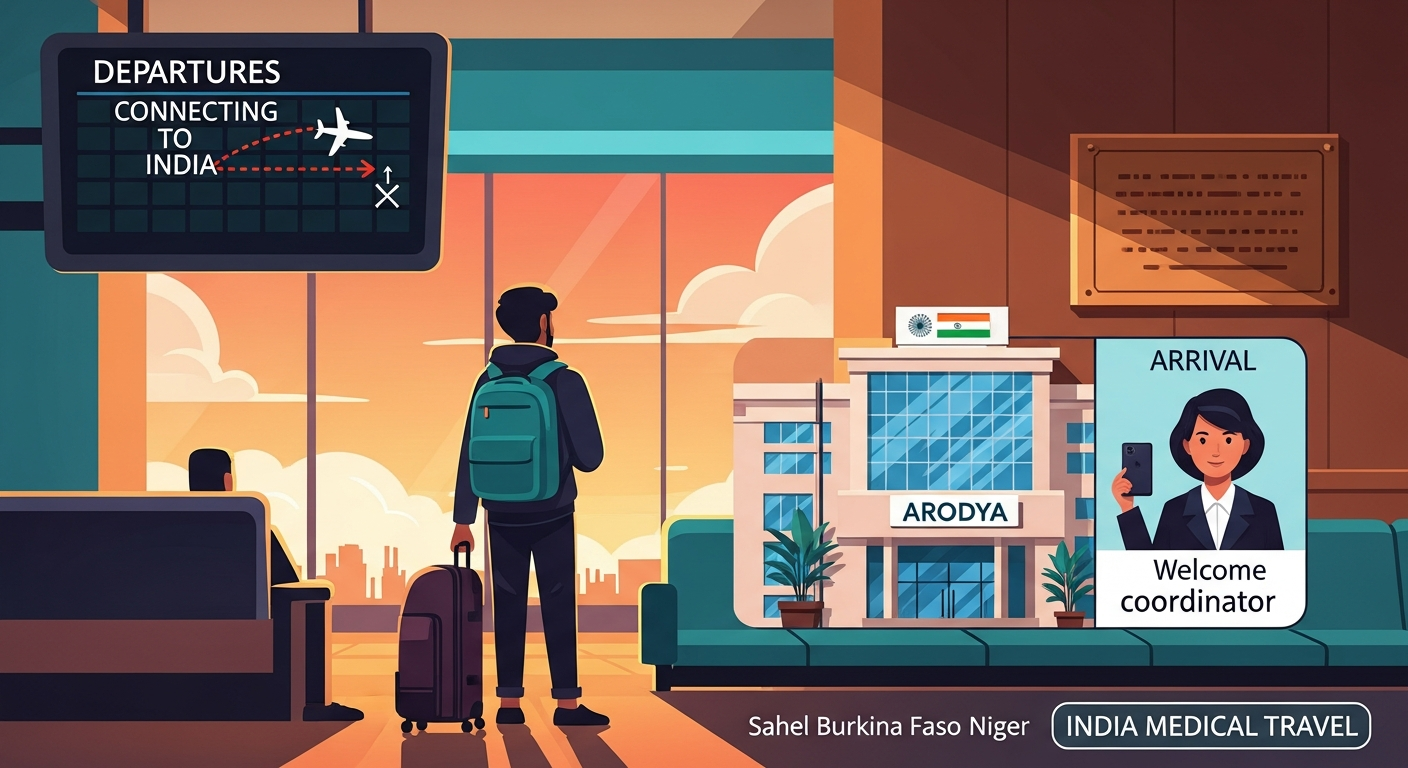
There are no direct flights from Ouagadougou (Burkina Faso) or Niamey (Niger) to any Indian city. Common connecting routes include:
Via Casablanca (Royal Air Maroc)
Ouagadougou → Casablanca → Mumbai or Delhi (connecting in Casablanca, total journey ~16–20 hours). This is often the most affordable and direct routing option and benefits from Royal Air Maroc's strong West Africa network.
Via Addis Ababa (Ethiopian Airlines)
Ouagadougou/Niamey → Addis Ababa → Delhi/Mumbai/Bangalore (total journey ~14–18 hours). Ethiopian Airlines has excellent connections from West Africa and is one of the most reliable carriers for the Africa-India route. This is often the smoothest option for medical patients due to Ethiopian Airlines' good onward connections.
Via Nairobi (Kenya Airways)
Ouagadougou → Nairobi → Mumbai (connecting in Nairobi, total ~18–22 hours). Kenya Airways' West Africa coverage is growing and this can be a competitive option.
Via Paris or Dubai
Some patients connect via Paris (Air France) or Dubai (Emirates/Air Arabia) to India. These add transit time but can sometimes offer better seat prices or travel logistics.
Arodya tip: When booking for a medical patient, select seats in economy with maximum legroom (exit row or bulkhead) to reduce DVT risk on a long flight. Consider Business Class for post-operative return journeys if the patient's condition warrants it — Arodya can advise on medical fitness to fly.
French Language Support in India
Language is the most frequently cited concern for Francophone African patients considering India. The reality is more reassuring than patients expect:
At the Hospital Level
Several major Indian hospitals have invested in Francophone patient services due to the growing volume of patients from Francophone Africa:
- Apollo Hospitals: French-speaking patient coordinators available at Delhi, Mumbai, and Hyderabad campuses. Written communications (reports, discharge summaries) can be translated to French on request.
- Fortis Healthcare: French language support available via interpreter service at major campuses.
- Medanta, Gurugram: International patient division has French language capabilities.
Via Arodya
Arodya's coordination team includes Francophone staff. All communication from initial enquiry through treatment coordination and post-discharge follow-up can be conducted in French. We also brief your Indian treating team on cultural communication preferences for Francophone West African patients.
Medical Interpreters
For clinical consultations where nuance matters — consent discussions, prognosis conversations, complex treatment decisions — Arodya can arrange certified medical interpreters in French who are familiar with the specific terminology of your treatment area.
The Indian Medical Visa Process for Burkina Faso and Niger
Indian Diplomatic Representation
Burkina Faso: India does not have an embassy in Ouagadougou. Burkina Faso nationals must apply at the Indian High Commission in Abidjan (Côte d'Ivoire) or the Indian Embassy in Accra (Ghana) — whichever is more accessible.
Niger: India's Embassy in Abuja, Nigeria covers Niger for visa purposes. Alternatively, the Indian Embassy in Rabat, Morocco may be accessible for some Niger nationals.
The Medical Visa (MED) Application
The medical visa requires:
- A completed Indian visa application form
- A letter from a recognised Indian hospital confirming appointment/admission
- Proof of financial means to cover treatment
- Passport valid for at least six months beyond intended stay
- Photographs meeting Indian visa specifications
Arodya provides: The hospital invitation/appointment confirmation letter — this is a standard part of our facilitation service and is essential for the medical visa.
Processing time: Typically five to fifteen working days. Apply at least four to six weeks before your planned travel date.
Duration: Medical visas are typically granted for one year with multiple entry and are extendable from within India up to five years.
Common Conditions Treated for Sahel Patients
Based on the patient profiles Arodya has coordinated from Francophone West Africa, the most common conditions requiring India travel include:
- Cardiac conditions: Valvular heart disease (rheumatic heart disease is common in the Sahel), coronary artery disease, congenital heart defects in children
- Cancer: Breast cancer, cervical cancer, colorectal cancer, paediatric cancers (Burkitt lymphoma, Wilms tumour)
- Kidney disease: End-stage renal disease requiring transplantation (dialysis facilities in the Sahel are extremely limited)
- Neurological conditions: Hydrocephalus in children, brain tumours, epilepsy surgery
- Orthopaedics: Hip and knee replacement for advanced arthritis, post-traumatic orthopaedic reconstruction
- Reproductive health: Infertility treatment, complex gynaecological surgery (vesico-vaginal fistula repair)
What to Expect on Arrival in India
Language: English is used in all clinical settings, with French interpretation available via Arodya. Indian medical teams are accustomed to communicating through interpreters.
Climate: India's climate in May–June (when this guide is written) is hot — similar to or hotter than the Sahel. Delhi temperatures exceed 40°C in May. Patients should be prepared and ensure they are well-hydrated. Chennai and Mumbai are more humid. Bangalore is cooler and more comfortable year-round.
Food: Halal food is widely available, as is vegetarian food, near most major hospital areas. Arodya pre-arranges dietary requirements.
Currency: Indian Rupees (INR). USD and EUR are easily exchanged at airports and banks. Arodya provides a pre-travel guide to financial management in India.
Safety: India is a safe destination for medical travellers. Major hospital areas in Delhi, Mumbai, Chennai, and Bangalore are established international patient zones with good security and infrastructure.
To begin your enquiry as a Burkina Faso or Niger patient, start your intake with Arodya. We communicate in French, we understand the Sahel context, and we will guide you through every step from initial medical opinion to your return home.
For guidance on planning your budget for treatment, see our budget medical trip guide.