Managing Anxiety Before Surgery Abroad: A Guide for International Patients


Managing Anxiety Before Surgery Abroad: A Guide for International Patients
Deciding to have surgery in another country takes courage. You have researched hospitals, compared costs, arranged visas and flights — but as the date approaches, anxiety often intensifies. This is not a sign of weakness. Pre-operative anxiety affects 60–80% of all surgical patients, and travelling thousands of kilometres from home adds dimensions of uncertainty that patients having surgery locally do not face.
This guide covers the specific sources of anxiety international patients experience before surgery in India and offers evidence-based strategies to manage them.
TL;DR: Pre-surgery anxiety abroad is normal and manageable. Key strategies include breathing exercises, journalling fears to reduce their power, requesting a pre-op counselling session at the hospital, bringing a companion, and understanding the surgery-day timeline in advance. Indian hospitals have dedicated support for international patients — ask for it.
Common Sources of Anxiety for International Patients
Understanding what you are anxious about is the first step toward managing it. Most international patients describe some combination of these concerns:
Fear of the surgical procedure itself. Concerns about anaesthesia, pain, complications, and outcomes affect patients regardless of where they have surgery.
Unfamiliar environment. India looks, sounds, and feels different from home. The climate, food, traffic, and cultural norms can feel overwhelming when you are already stressed about a procedure.
Language barriers. Doctors and nurses at major Indian hospitals speak English fluently, but the surrounding environment may not. This can create a sense of isolation.
Being away from family. Surgery is a vulnerable time. Being separated from your support network removes emotional grounding precisely when you need it most.
Financial pressure. Even though treatment in India costs less than at home, worrying about whether you have budgeted enough adds to the stress.
Loss of control. At home, you know how things work. Abroad, you depend on others for transport, communication, and navigation of the healthcare system.
Evidence-Based Coping Strategies
1. Controlled Breathing Exercises
The simplest and most immediately effective tool for acute anxiety is controlled breathing. The 4-7-8 technique is well-studied and takes under two minutes:
- Inhale through your nose for 4 seconds
- Hold your breath for 7 seconds
- Exhale slowly through your mouth for 8 seconds
- Repeat 3–4 times
This activates the parasympathetic nervous system, lowering heart rate and blood pressure. Practice it daily in the weeks before surgery so it becomes automatic when you need it most — in the hospital bed the night before your procedure.
2. Journalling and Writing Down Fears
Anxiety thrives on vagueness. Writing fears down — on paper or in a phone note — forces you to articulate them specifically. Instead of "I'm scared about surgery," write: "I'm worried about anaesthesia because I've never had general anaesthesia before." A specific fear can be addressed with specific information — ask your anaesthesiologist to explain exactly what will happen.
3. Pre-Operative Counselling
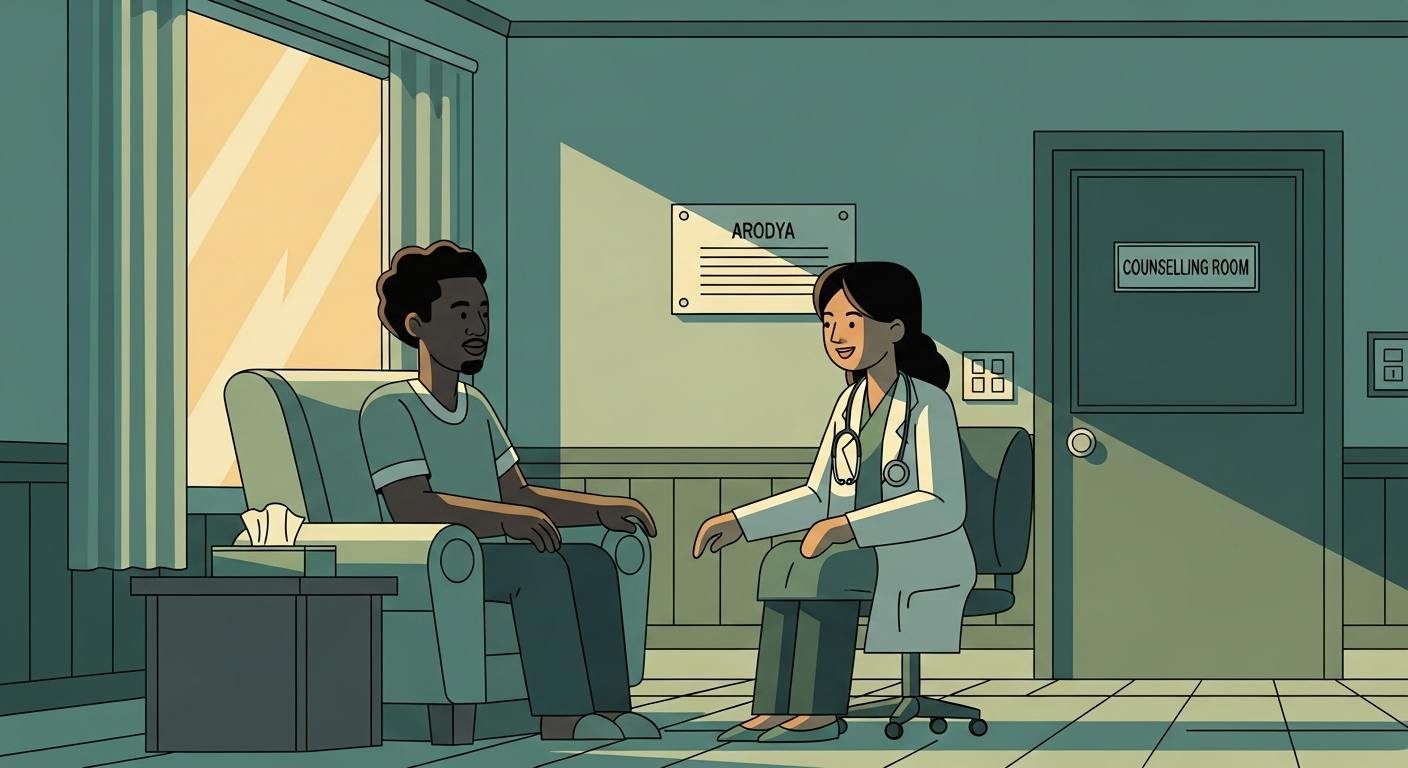
Major Indian hospitals — Apollo, Fortis, Medanta, Narayana, Max Healthcare — have clinical psychologists and counsellors on staff. International patient departments can arrange a pre-operative counselling session, often in English, specifically designed to help you process anxiety before surgery.
This is not a sign that something is wrong with you. It is a standard part of comprehensive surgical care. Ask your hospital coordinator to schedule a session 1–2 days before your procedure. For patients dealing with more complex emotional responses, our guide on coping with a medical diagnosis abroad covers the psychological support services available in greater depth.
4. Information Gathering
The more you know about what will happen, the less room there is for worst-case scenarios. Before surgery, ask your surgeon or hospital coordinator:
- What time will I be taken to the operating theatre?
- How long will the surgery take?
- What type of anaesthesia will be used?
- Where will I wake up and who will be there?
- What will the first 24 hours after surgery look like?
- When can my companion see me after the procedure?
Write down the answers. A concrete timeline reduces the sense of chaos on surgery day.
5. Physical Activity
If your medical condition allows it, light activity before surgery — walking, gentle stretching, or yoga — reduces cortisol levels and improves sleep quality. Sleep deprivation worsens anxiety, so anything that helps you sleep better the nights before surgery is worth doing.
The Role of Companion Travel
Travelling with a companion is one of the most effective buffers against pre-surgery anxiety. A companion provides:
- Emotional support during the waiting periods that are hardest to endure alone
- Practical help with meals, pharmacy runs, and communicating with hospital staff
- Connection to home — updating your family and maintaining a sense of normality
- Advocacy during recovery when you may be too tired to communicate clearly
Most Indian hospitals allow one companion to stay in the patient room at no extra charge or a nominal daily fee. It is strongly recommended for any procedure involving general anaesthesia or a hospital stay of more than 2 days.
What to Expect on Surgery Day
Knowing the typical surgery-day sequence at an Indian hospital removes much of the "what if" anxiety:
The evening before: You will be admitted and settled into your room. A nurse takes baseline vitals (blood pressure, temperature, pulse, oxygen saturation). You will be asked to fast from midnight — no food or water.
Morning of surgery: The anaesthesiologist visits to explain the anaesthesia plan, review your allergies, and answer questions. Your surgeon may visit briefly to confirm the procedure and mark the surgical site if applicable. You change into a hospital gown.
Transfer to theatre: A hospital attendant wheels your bed to the pre-operative holding area. Your companion can walk with you to this point. The anaesthesia team starts an IV line.
In the operating theatre: General anaesthesia takes effect within seconds. The next thing you are aware of is waking up in the recovery room.
Recovery room: You wake with nurses monitoring you. You may feel groggy or nauseous — both normal. Once stable, you return to your room where your companion is waiting.
When Anxiety Needs Professional Support
Normal pre-surgery anxiety is temporary and manageable with the strategies above. However, if you experience any of the following, ask for professional support:
- Panic attacks (heart racing, difficulty breathing, feeling of impending doom)
- Inability to sleep for multiple consecutive nights
- Persistent crying or feeling of hopelessness
- Intrusive thoughts about death or harm
- Desire to cancel the surgery despite knowing it is medically necessary
These responses do not mean you should not have surgery — they mean you need additional support, and that support is available. If you are planning your first trip to India for treatment, our first-time travel guide walks through every stage from arrival to departure.
The goal is not to eliminate anxiety entirely. Some nervousness before surgery is a healthy human response. The goal is to keep it at a level where it does not interfere with your ability to make good decisions, rest adequately, and move forward with the treatment you have chosen.