

Sleep Disorders Treatment in India: Sleep Apnea, Insomnia & Polysomnography for International Patients
Sleep is not a luxury — it is a biological necessity. Chronic sleep disorders are associated with hypertension, coronary artery disease, type 2 diabetes, obesity, depression, and significantly increased mortality. Yet sleep medicine remains one of the most under-resourced specialities in Africa, with few sleep laboratories, limited awareness of sleep-disordered breathing among general physicians, and essentially no access to advanced diagnostic polysomnography outside major capitals. India's sleep medicine centres offer comprehensive diagnosis and treatment — polysomnography, CPAP titration, surgical options for sleep apnea, and evidence-based insomnia therapy — at a fraction of Western costs.
TL;DR: Polysomnography (sleep study) costs USD 200–500 in India versus USD 1,500–3,000 in the USA. CPAP machines are 30–50% cheaper than Western retail. Sleep apnea surgery (MMA) costs USD 5,000–9,000. CBT-I for insomnia is available at leading centres. Untreated OSA doubles cardiovascular risk.
The Spectrum of Sleep Disorders
Obstructive Sleep Apnea (OSA)
OSA is the most common serious sleep disorder, affecting an estimated 15–20% of adults globally. The upper airway collapses repeatedly during sleep, causing oxygen desaturation, arousal, and fragmented sleep architecture.
Classic symptoms:
- Loud snoring witnessed by a bed partner
- Observed apneas (partner notices the patient stop breathing)
- Non-restorative sleep despite adequate time in bed
- Excessive daytime sleepiness
- Morning headaches
- Cognitive impairment, irritability
OSA classification by AHI (apnea-hypopnea index):
- Mild: AHI 5–14 events/hour
- Moderate: AHI 15–29 events/hour
- Severe: AHI ≥30 events/hour
OSA is dramatically under-recognised in Africa. Many patients presenting to Arodya's partners for cardiac or metabolic conditions are found incidentally to have significant OSA. Treating OSA in cardiac patients improves blood pressure control, reduces arrhythmia burden, and decreases cardiovascular events.
Central Sleep Apnea (CSA)
CSA occurs when the brain fails to send appropriate signals to breathing muscles. It is common in heart failure patients (Cheyne-Stokes breathing), opioid users, and at high altitude. Management differs from OSA — CPAP alone may be insufficient; adaptive servo-ventilation (ASV) or bilevel PAP may be needed.
Insomnia Disorder
Chronic insomnia — difficulty initiating or maintaining sleep, or non-restorative sleep with daytime consequence, occurring ≥3 nights/week for ≥3 months — affects an estimated 10–15% of adults. It is significantly underdiagnosed and overtreated with medications rather than the evidence-based first-line: Cognitive Behavioural Therapy for Insomnia (CBT-I).
Restless Legs Syndrome (RLS)
An uncomfortable urge to move the legs, particularly at rest and in the evening, causing delayed sleep onset. Ferritin deficiency is a common treatable cause — iron supplementation resolves RLS in many patients. Dopamine agonists or alpha-2-delta ligands are used for refractory cases.
Narcolepsy
A neurological disorder causing excessive daytime sleepiness, cataplexy (sudden muscle weakness triggered by emotion), and sleep paralysis. Requires polysomnography and multiple sleep latency test (MSLT) for diagnosis. Treated with stimulants, sodium oxybate, or pitolisant. Available at Indian neurology and sleep centres.
Diagnostic Testing at Indian Sleep Centres
In-Laboratory Polysomnography (PSG)
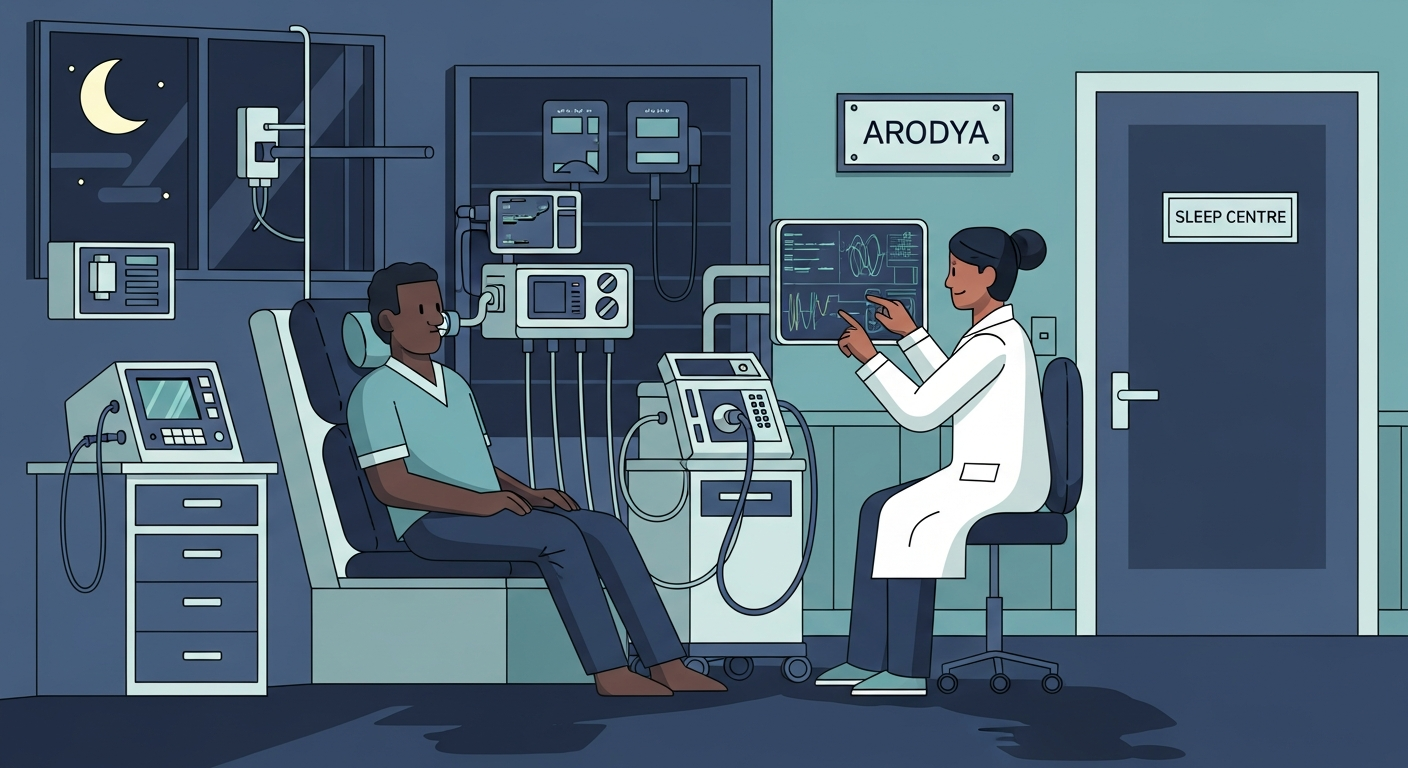
The gold-standard sleep study. Performed overnight in a monitored sleep laboratory room (not a hospital ward — sleep lab rooms are designed to be comfortable and sleep-conducive).
Parameters monitored:
- EEG (brain waves — sleep staging)
- EOG (eye movements — REM identification)
- EMG (chin and leg muscle activity — cataplexy, RLS)
- Airflow (nasal thermistor and pressure transducer)
- Respiratory effort (thoracic and abdominal belts)
- SpO2 (oxygen saturation — oxygen desaturation events)
- ECG (heart rhythm — OSA-associated arrhythmias)
- Body position
Results provide: AHI, oxygen desaturation index (ODI), sleep efficiency, sleep stage distribution, arousal index.
Cost in India: USD 200–500 (versus USD 1,500–3,000 in USA, USD 800–2,000 in UK).
Split-Night Study
For patients with obvious moderate-severe OSA, some centres perform a combined diagnostic + CPAP titration study in a single night — first half diagnostic, second half CPAP titration once OSA is confirmed. Saves one night and reduces cost.
CPAP Titration Study
Separate overnight study with CPAP pressure manually adjusted while the patient sleeps until the optimal pressure eliminating all respiratory events is determined. Used when manual titration is preferred over auto-CPAP.
Home Sleep Apnea Testing (HSAT)
A simplified portable device used at home or in hospital accommodation recording airflow, SpO2, and respiratory effort — sufficient to diagnose moderate-severe OSA without overnight laboratory stay. Not suitable for patients with heart failure, neuromuscular disease, or suspected non-OSA sleep disorder.
Cost in India: USD 80–150.
Multiple Sleep Latency Test (MSLT)
Performed the day after overnight PSG, the MSLT measures how quickly a patient falls asleep during five nap opportunities. Objective measure of sleepiness; also detects sleep-onset REM periods diagnostic of narcolepsy.
Cost in India: USD 150–300 (performed same day as preceding PSG).
Treatment Options in India
CPAP Therapy
CPAP is the first-line treatment for moderate-severe OSA and mild OSA with cardiovascular comorbidities or daytime sleepiness. An air compressor delivers pressurised air through a mask to keep the upper airway open during sleep.
CPAP machines in India: ResMed, Philips, and Fisher & Paykel CPAP devices are available at 30–50% below Western retail prices. Auto-CPAP machines cost USD 300–600 in India versus USD 600–1,200 in the USA.
After diagnosis, Arodya assists with customs documentation for travelling home with a CPAP machine and a prescription/certificate for continued use at home.
Mandibular Advancement Device (MAD)
For mild-moderate OSA or patients intolerant of CPAP, a custom dental device holding the lower jaw forward reduces upper airway collapse. Custom MADs are available from Indian dental sleep medicine specialists for USD 300–600.
Surgical Treatment of OSA
When anatomy is the primary cause of airway obstruction and CPAP is not tolerated:
Level 1 surgery (palate and tonsils):
- Uvulopalatopharyngoplasty (UPPP): USD 2,500–4,500
- Tonsillectomy/adenoidectomy (for selected patients): USD 1,500–3,000
- Radiofrequency tissue reduction: USD 1,500–3,000
Level 2 surgery (tongue base and jaw):
- Tongue base reduction: USD 2,500–4,000
- Genioglossal advancement: USD 3,000–5,000
Maxillomandibular Advancement (MMA) — most effective surgical option:
Both upper and lower jaws are surgically advanced 8–12mm, dramatically enlarging the pharyngeal airway. 85–90% resolution of OSA. India costs: USD 5,000–9,000. Considered when other surgical approaches fail or for patients preferring surgery to lifelong CPAP.
Hypoglossal Nerve Stimulation (Inspire): Available at select Indian centres for patients with moderate-severe OSA who fail CPAP and are not suitable for MMA. Device cost and implant surgery: USD 15,000–20,000 in India versus USD 40,000–60,000 in the USA.
CBT-I for Insomnia
Cognitive Behavioural Therapy for Insomnia is more effective than sleep medications for chronic insomnia and has no side effects or dependency risk. CBT-I involves:
- Sleep restriction therapy (paradoxically reducing time in bed to increase sleep pressure)
- Stimulus control (re-associating bed with sleep, not wakefulness)
- Cognitive restructuring (addressing dysfunctional beliefs about sleep)
- Sleep hygiene optimisation
- Relaxation techniques
A typical CBT-I programme involves 6–8 weekly sessions. Indian psychology departments at sleep centres offer CBT-I individually and in group format. Remote (teleconsultation) CBT-I is also available for international patients completing the programme from home.
OSA and Cardiovascular Disease: Why This Matters
For patients travelling to India for cardiac conditions, sleep assessment should be part of the workup. The links are well-established:
- Hypertension: OSA is the most common secondary cause of resistant hypertension. Treating OSA reduces ambulatory blood pressure by 3–5 mmHg.
- Atrial fibrillation: OSA increases AF risk 4-fold and significantly reduces AF ablation success rates. Treating OSA before AF ablation improves outcomes.
- Heart failure: Central sleep apnea in heart failure increases mortality. Treatment with ASV improves cardiac function in selected patients.
- Post-CABG and post-valve surgery: OSA impairs post-operative recovery and increases respiratory complications.
Indian cardiac departments at top centres now routinely screen cardiac patients for OSA. For patients having cardiac surgery, sleep evaluation during the India stay is recommended. See our heart bypass surgery guide for cardiac procedure details.
For managing pre-surgery anxiety (relevant for patients about to undergo sleep procedures), our anxiety before surgery abroad guide provides practical strategies.
Sleep quality transforms quality of life. If you or someone you care for snores loudly, wakes unrefreshed, or struggles with daytime sleepiness, the cause can be diagnosed and treated. Request a sleep medicine consultation through Arodya — share your symptoms and any existing assessments for a personalised recommendation.