Bone Cancer & Orthopaedic Tumour Surgery in India: Limb Salvage Guide 2026

A bone cancer diagnosis carries a particular dread — the fear that treatment may require sacrifice of a limb. For decades, amputation was often the unavoidable consequence of bone sarcomas affecting the limbs. Today, India's orthopaedic oncology centres are writing a different story. Limb-salvage surgery, the specialised discipline of removing bone tumours while preserving the limb, is now achieving rates of 80–90% in appropriately selected patients at India's leading cancer centres. For African patients — often diagnosed young, often presented with large tumours — this represents a transformative change in what treatment can offer.
Bone Tumours in Africa: The Epidemiological Context
Primary bone tumours — cancers arising from bone tissue itself — are relatively rare globally, accounting for less than 1% of all malignancies. However, they disproportionately affect children and young adults, making their impact on years of life lost significant. In Africa, where the median population age is young, bone sarcomas affect a demographic with decades of productive life ahead.
Osteosarcoma is the most common primary bone cancer, most frequently occurring in the distal femur (just above the knee), proximal tibia (just below the knee), and proximal humerus (upper arm), during periods of rapid bone growth in adolescence. The typical presentation is a young person aged 10–25 with pain and swelling around the knee, initially attributed to sports injury. Delay in diagnosis — sometimes months — is common in Africa where imaging access is limited.
Ewing sarcoma is the second most common bone sarcoma in children and young adults. It can occur in any bone, including flat bones (pelvis, ribs, spine), making presentation more varied. Ewing sarcoma is highly chemotherapy-sensitive, which influences treatment planning significantly.
Chondrosarcoma typically affects older adults (30–60 years) and is relatively chemotherapy-resistant, making surgery the primary treatment modality. It grows slowly but can reach large sizes before diagnosis.
Metastatic bone disease — cancer from another organ (breast, prostate, lung, kidney, thyroid) spreading to bone — is far more common than primary bone tumours. While not curable in most cases, surgery can provide critical stability and pain relief, preventing pathological fracture and maintaining quality of life.
Staging Bone Tumours
Accurate staging before any surgical planning is essential. The Musculoskeletal Tumor Society (MSTS) staging system and the AJCC system are both used.
Key staging investigations include:
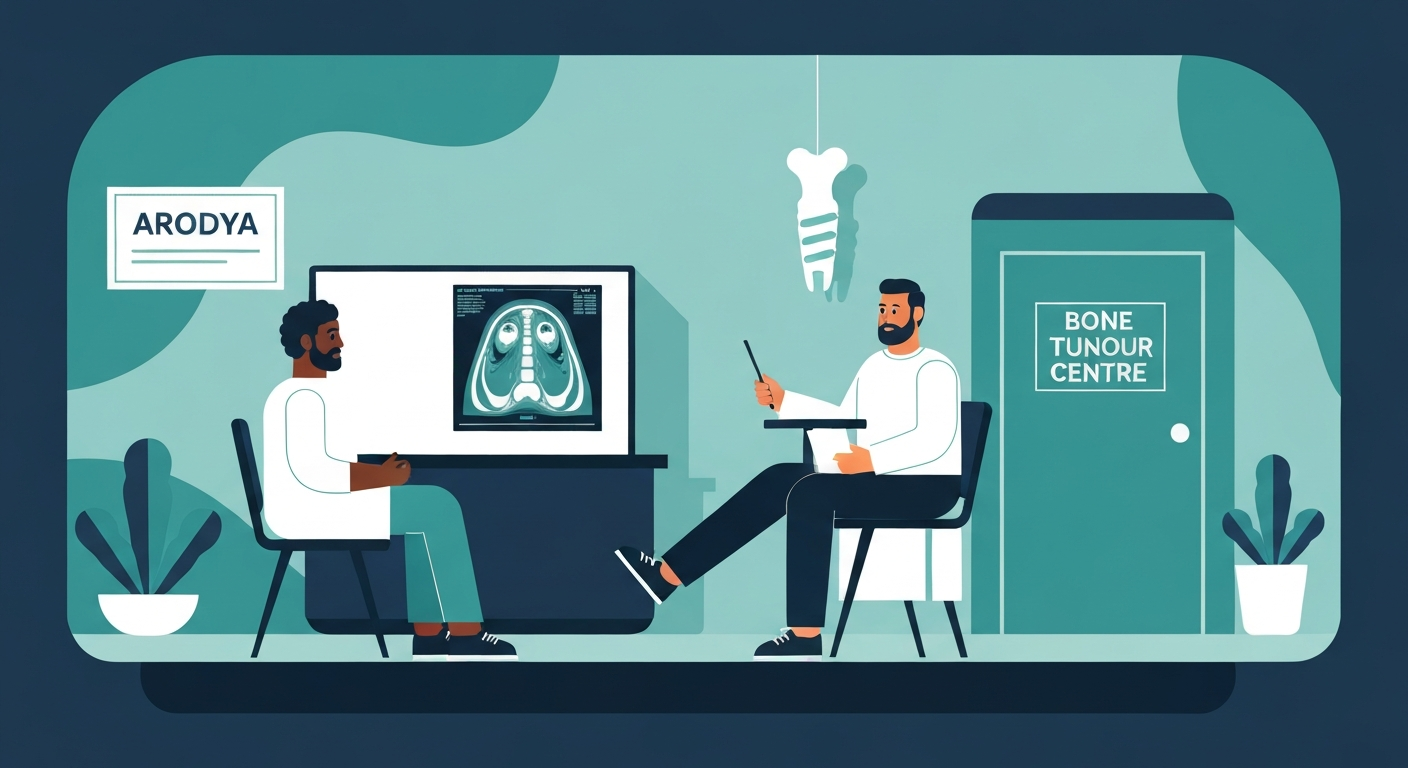
MRI of the primary tumour: Defines the tumour's relationship to surrounding soft tissue, nerves, blood vessels, and joint surfaces. This is the most critical imaging for surgical planning.
CT of the chest: Detects pulmonary metastases, which are present at diagnosis in 15–20% of osteosarcoma patients.
Bone scan or PET-CT: Identifies skip lesions (satellite tumour deposits within the same bone) and distant bone metastases.
Biopsy: Confirms the diagnosis histologically. Critically, the biopsy must be planned by the operating orthopaedic oncologist — a poorly placed biopsy can compromise subsequent limb-salvage surgery by contaminating tissue planes.
India's cancer centres strongly prefer that patients arrive for staging and biopsy before any local treatment, allowing the full staging workup and biopsy to be performed in a coordinated, oncologically safe manner.
Limb Salvage vs Amputation: The Decision
The decision between limb-salvage surgery and amputation is made on technical, oncological, and functional grounds:
Limb salvage is possible when:
- The major neurovascular bundle (main artery, vein, and nerve to the limb) is not invaded by tumour
- Adequate surgical margins can be achieved around the tumour
- A stable, functional reconstruction is possible after bone and soft tissue removal
- Response to neoadjuvant chemotherapy has reduced tumour volume (for chemo-sensitive tumours)
Amputation is necessary when:
- Major vessels or nerves cannot be preserved
- The tumour is too extensive for meaningful limb function to remain
- Pathological fracture has contaminated tissue planes, compromising margins
- The patient's general condition makes lengthy complex surgery unsafe
Modern studies show that survival rates are equivalent between limb salvage and amputation when margins are comparable — the key outcome difference is function and quality of life, which are significantly better with limb salvage. India's orthopaedic oncology teams achieve limb salvage in 80–90% of appropriately selected cases.
Reconstruction Options After Tumour Resection
After en bloc resection of the tumour-bearing bone segment, the orthopaedic oncologist must reconstruct the limb structurally and functionally.
Modular Endoprostheses (Custom Metal Implants)
The most widely used reconstruction method in India. A modular metal implant system replaces the resected bone segment and joint. The modular design allows intraoperative customisation to match the precise segment length and joint geometry. Immediate stability allows early weight-bearing and mobilisation.
For growing children with lower limb tumours, expandable (growing) prostheses allow limb lengthening procedures to keep pace with the unaffected limb as the child grows — preventing limb length discrepancy without repeated surgery.
Survival of prosthesis: Modern modular endoprostheses last 10–20+ years in many patients. Revision surgery is possible when implants wear or loosen.
Intercalary Reconstruction (Allograft or Vascularised Fibula)
For tumours in the shaft of long bones (away from the joint), the joint-sparing reconstruction options are preferable. Bone allografts (cadaveric donor bone) or vascularised fibula grafts (the patient's own fibula, transferred with its blood supply) can reconstruct the resected shaft segment.
Vascularised fibula grafts are particularly valuable in growing children — the transferred bone grows and remodels into the reconstructed limb over time, eventually providing structural support without an implant.
Allograft-Prosthesis Composite
Combines cadaveric bone with a metal implant — used when the tumour involves the joint surface, preserving the surrounding muscular attachments that provide limb function.
Neoadjuvant Chemotherapy: Shrinking the Tumour First
For osteosarcoma and Ewing sarcoma, chemotherapy is given before surgery (neoadjuvant) for several reasons:
- Tumour shrinkage: Reducing tumour size improves the feasibility of limb salvage and reduces the volume of tissue requiring resection
- Treating micrometastases: Chemotherapy given before surgery treats microscopic spread that cannot be imaged
- Histological response assessment: Examining the resected tumour for chemotherapy-induced necrosis guides post-operative chemotherapy — good responders (>90% necrosis) have significantly better prognosis
MAP protocol for osteosarcoma (methotrexate, doxorubicin/adriamycin, cisplatin): 3 cycles pre-operatively, 3 post-operatively. Cost in India: $5,000–10,000 per 3-cycle course (vs $30,000–50,000 USA).
VDC/IE protocol for Ewing sarcoma (vincristine, doxorubicin, cyclophosphamide alternating with ifosfamide, etoposide): Extended course over 9–12 months. Cost in India: significantly lower than Western countries due to generic drug availability.
Cost Comparison
| Treatment | India (USD) | USA (USD) |
|---|---|---|
| Staging workup (MRI + CT + bone scan) | 800–1,500 | 5,000–12,000 |
| Biopsy (open or core needle) | 500–1,000 | 3,000–8,000 |
| Limb salvage + endoprosthesis | 15,000–25,000 | 60,000–120,000 |
| Osteosarcoma chemotherapy (full course) | 10,000–20,000 | 60,000–120,000 |
| Ewing sarcoma multimodal treatment | 20,000–35,000 | 100,000–200,000 |
Tata Memorial Hospital: India's Orthopaedic Oncology Centre of Excellence
Tata Memorial Hospital in Mumbai is India's premier cancer institution and operates one of Asia's highest-volume orthopaedic oncology programmes. The department treats hundreds of bone and soft tissue sarcoma cases annually, publishing outcome data that compares favourably with leading international centres.
AIIMS Delhi offers equivalent expertise through its government hospital structure, at lower costs. Apollo Cancer Centres, Max, and Manipal round out the accredited network of bone tumour programmes in India.
Starting Your Bone Tumour Assessment
For patients in Africa with a bone tumour diagnosis, time matters. Osteosarcoma progresses rapidly, and staging and treatment initiation should not be delayed. Review cancer treatment costs in India vs the USA to understand the financial picture, then begin your assessment with Arodya immediately through our intake form.
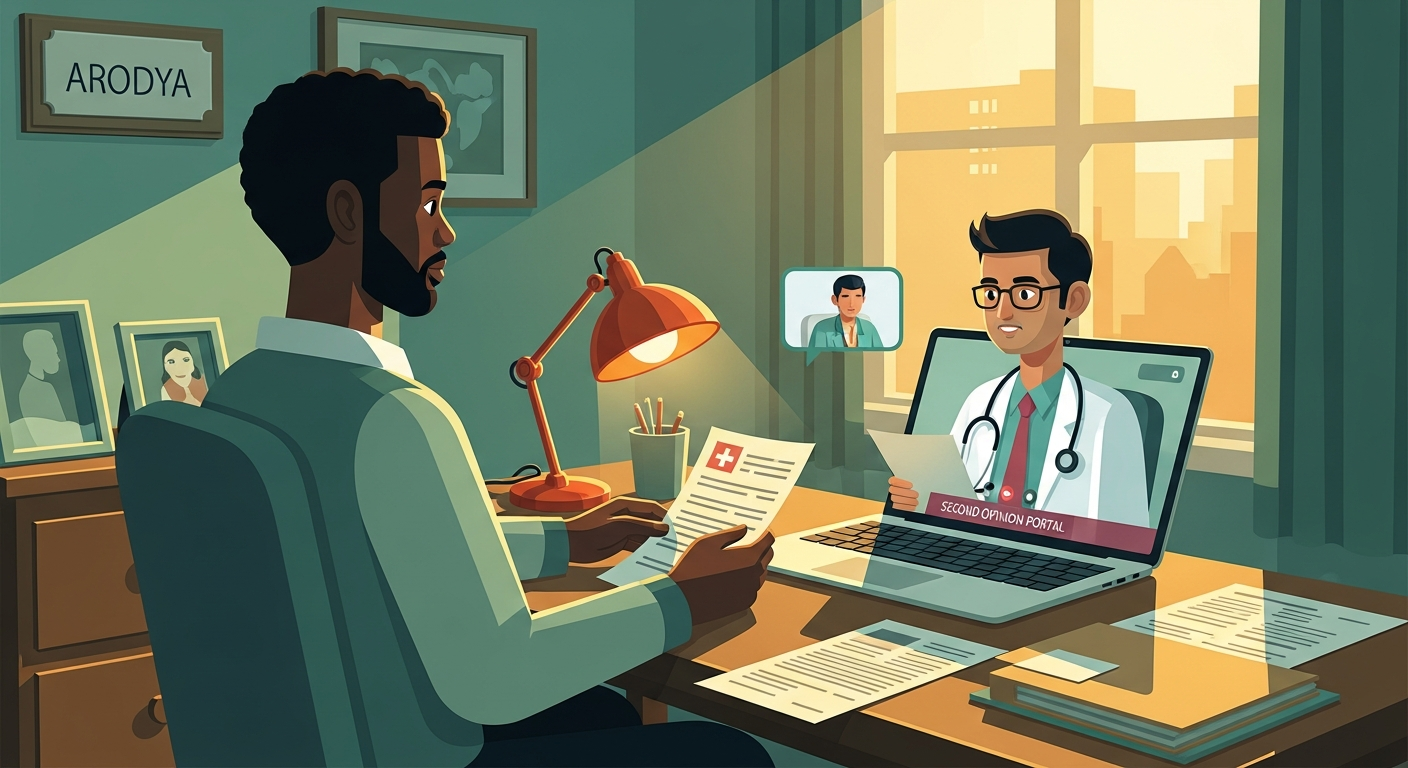
Share your MRI and CT imaging, biopsy report if available, and a description of your symptoms and timeline. Arodya's coordination team will review your records urgently and connect you with the appropriate orthopaedic oncology specialist within 24 hours. For acute cases requiring urgent attention, expedited review and appointment booking is available.
Limb preservation is achievable. India's orthopaedic oncology teams are the bridge between a bone cancer diagnosis and a future with a functioning limb.