Navigating Indian Hospitals for the First Time: What International Patients Really Need to Know
Navigating Indian Hospitals for the First Time: What International Patients Really Need to Know
You've flown hours from home. You're in a vast, bustling Indian hospital with hundreds of people moving in every direction. Signs are in Hindi and English. The queue at registration looks endless. You have a folder of medical reports, you're jet-lagged, and you're nervous about what the doctor will say.
First-time international patients at Indian hospitals describe this moment — arrival — as one of the most disorienting of their medical journey. The good news: Indian hospitals that serve international patients have invested significantly in making this experience manageable. And with the right preparation, your first visit will feel far less overwhelming than you expect.
This guide walks you through every step of navigating a major Indian hospital as an international patient.
Before You Arrive: Registration and Appointments
Pre-registering as an international patient
Major Indian hospitals have International Patient Services (IPS) departments specifically designed for foreign patients. These are separate from the regular Indian OPD queue and provide a significantly more streamlined experience.
When you travel with Arodya, your appointment and registration are arranged before you arrive. You should never turn up at a major Indian hospital without a pre-arranged appointment with the international patient desk. Walk-in visits to the general OPD will leave you in a queue of hundreds of Indian patients, without the dedicated attention the international service provides.
If you are registering independently, contact the hospital's international desk directly (most have a dedicated email and WhatsApp number listed on their website) and request an appointment specifying:
- Your country of origin
- Your diagnosis or the specialist you need
- Your preferred dates
- Your medical records summary (send in advance so the doctor can review before your appointment)
Documents to prepare:
- Passport (original + photocopy)
- Visa (medical visa stamp page)
- All medical records: reports, scan CDs, pathology results, blood tests, discharge summaries from prior hospitalisations
- List of current medications (with international generic names, not just brand names from your country)
- Insurance documents if applicable
Arrival at the Hospital: The First 30 Minutes
The lobby
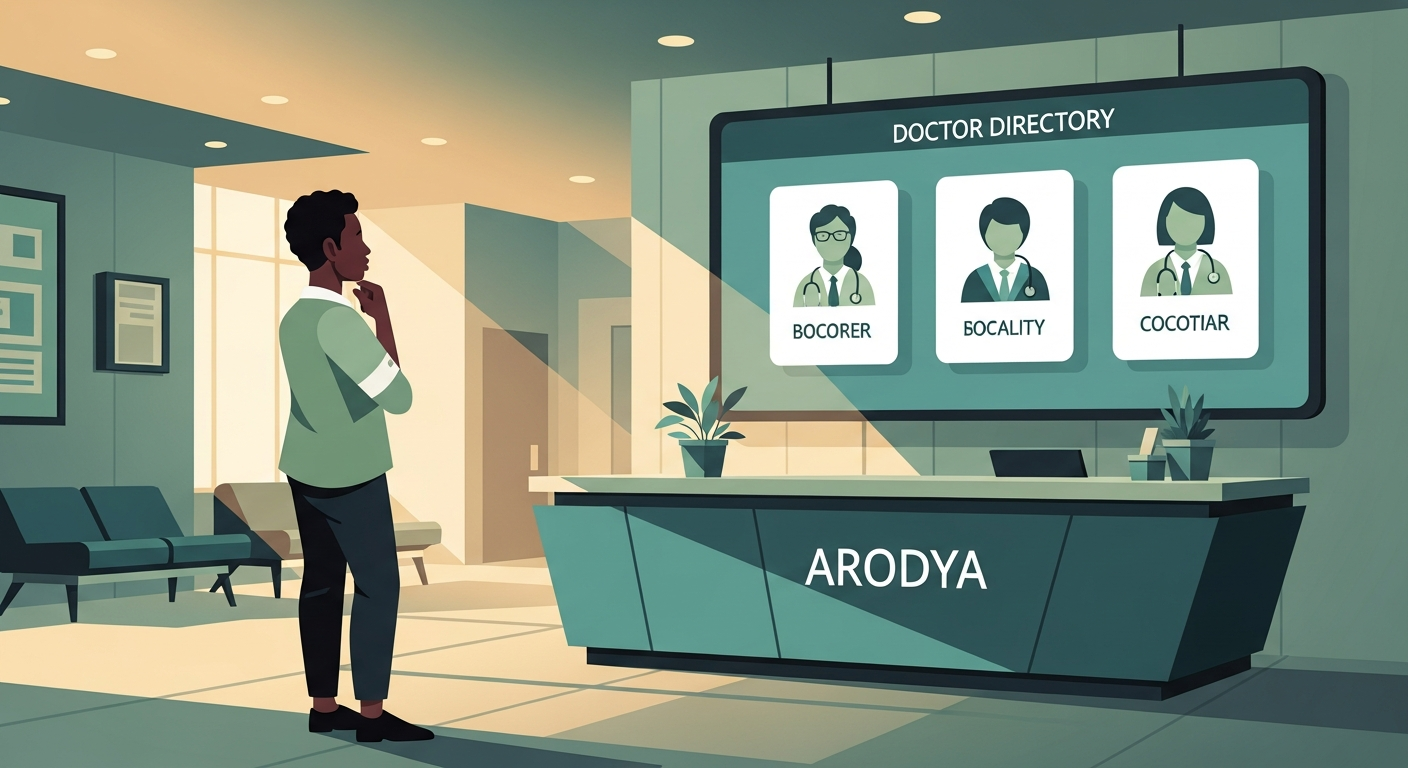
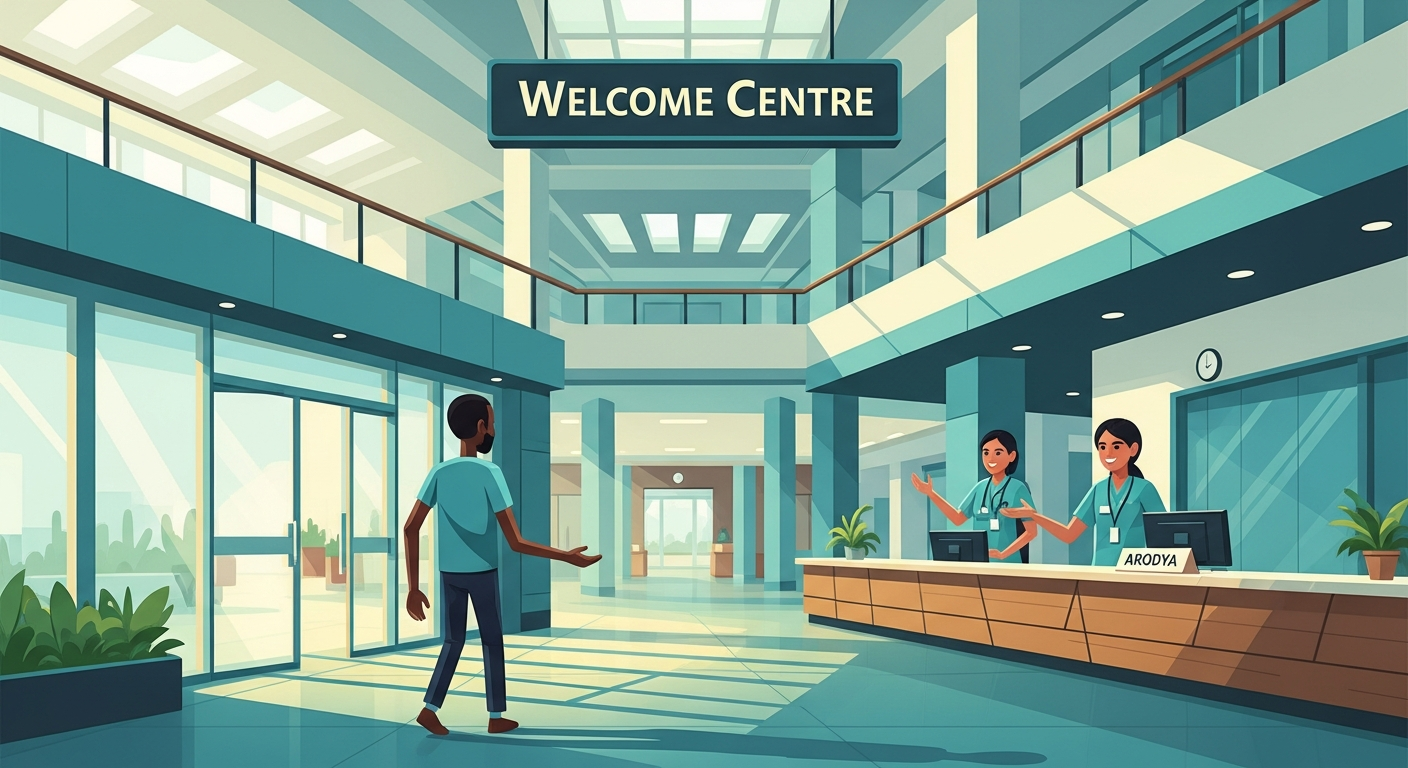
Indian hospital lobbies at major private institutions are large, modern spaces — not unlike airports. You will see information desks, security checkpoints, multiple lifts, and dozens of directional signs. Approach the front information desk and ask for the International Patient Services desk specifically.
Security check
Most major Indian hospitals have airport-style security at entrances. You will pass through a metal detector and your bag may be X-rayed. Medicines in your bag should be in their original packaging — keep prescriptions with them to avoid any questions.
International Patient Services desk
This is your first stop. The IPS coordinator will:
- Verify your passport and visa
- Complete registration (you'll receive a unique hospital identification number — keep this; it's needed for every interaction at the hospital)
- Confirm your appointment time and specialist
- Assign you a patient coordinator if the hospital provides this service
- Give you a hospital map and explain which floor/department to go to
The patient card / file
You'll receive a physical hospital file folder and usually a wristband. Keep the file with you throughout your visit — test results, prescriptions, and consultation notes are added to it.
The OPD (Outpatient Department) Consultation
Waiting time
Even with an appointment, expect some waiting. Indian hospital outpatient departments see enormous volumes. A 30-minute wait after your appointment time is common; 60 minutes is not unusual. Bring water, snacks, and something to read.
What happens in the consultation
Indian specialist consultations at international patient level tend to be thorough. The doctor will:
- Review your medical records (have them organised by date — most recent first)
- Take a history (ask about symptoms, duration, prior treatments)
- Perform a clinical examination
- Explain their assessment and plan
- Order investigations or prescribe treatment
Consultations for international patients typically run 20–45 minutes — longer than a typical Indian OPD slot — because the doctor understands that patients have travelled far and need thorough explanation.
Asking questions
Prepare your questions in advance. Write them down. Doctors appreciate organised patients. Common questions to ask:
- "What exactly is my diagnosis?"
- "What are my treatment options?"
- "What is the recommended approach and why?"
- "What are the risks of this procedure?"
- "What is the realistic outcome?"
- "How long will I need to stay in India?"
- "What follow-up will I need at home?"
Do not leave the consultation until you understand the plan. Ask for a written summary — most international patient departments provide typed consultation notes.
Investigations (Tests) in India
After the consultation, you will likely be directed to various investigation departments for blood tests, imaging, or other diagnostics. This is where knowing the hospital layout matters.
Blood tests / pathology
The phlebotomy (blood collection) department is usually on the ground floor. International patients registered through IPS generally have a faster queue. Tests requested by your specialist are entered into the hospital system; simply present your patient card.
Results turnaround: Routine blood tests are typically ready in 2–4 hours. If you need results before a follow-up same day, ask the lab about the turnaround time.
Imaging (X-ray, CT, MRI, ultrasound)
Take your patient card and the imaging request form from your doctor to the radiology department. Scheduling varies:
- X-ray: usually done the same day, often within 1–2 hours
- Ultrasound: same day or next day
- CT scan: usually same or next day
- MRI: may have 1–2 day wait at busy centres; sometimes same day if urgent
For major procedures (CT, MRI), you may need to fast for a few hours beforehand. Ask the radiology desk about preparation requirements when you arrive.
Biopsy or endoscopy
These procedures require separate bookings and often a pre-procedure assessment. Your coordinator will schedule these for you.
Practical Hospital Navigation Tips
Getting around
Indian hospital buildings are large and sometimes confusing. Department signs are in English but Indian hospital naming conventions differ from what you may know:
- "OPD" = outpatient department (clinics)
- "IPD" = inpatient department (wards)
- "CSSD" = Central Sterile Supply Department (not patient-facing)
- "NICU/PICU/ICU" = intensive care (critical care)
- "Casualty" or "Emergency" = emergency department
When in doubt, ask at the nearest nursing station — Indian hospital nurses are generally helpful to confused international patients.
Floors and departments
Pick up a hospital map at the IPS desk. Most major hospitals have information kiosks on each floor. Digital wayfinding systems (apps and touchscreen kiosks) are available at Apollo, Fortis, and Medanta.
Cafeteria and food
Major Indian hospitals have multiple food options: cafeterias, coffee shops, and sometimes food courts. Halal options are available at most. Vegetarian food is extremely abundant. For patients with dietary restrictions due to their condition (pre-operative, diabetic, dialysis), ask the IPS desk for guidance.
Pharmacy
Hospital pharmacies are usually located on the ground floor or near the discharge area. Prescriptions from hospital doctors can be filled here. For international patients seeking generic versions of expensive medications, ask the pharmacist specifically about available generics — they are legally obliged to dispense if available.
Cultural Differences to Understand
Hierarchy and formality
Indian medical culture is more hierarchical than what patients from some African countries or from Western countries may be used to. Senior consultants may have junior doctors present who don't speak during consultations. The senior doctor's word is generally final. If you want a second opinion from another specialist within the hospital, request this through the IPS desk — it's not offensive to ask.
Directness
Indian doctors can be very direct about diagnoses and prognosis — sometimes more bluntly than patients expect. Conversely, they may be reluctant to deliver bad news without family present. If you want full information regardless of prognosis, state this clearly: "I want to know everything, even if it is difficult to hear."
Family involvement
Indian medical culture assumes family involvement in decision-making. Decisions about major surgery or treatment are often discussed with family, not just the patient. If you are travelling alone and prefer to make decisions independently, communicate this clearly.
Queues and waiting
India's hospital systems serve enormous patient volumes. Patience is essential. Processes that feel bureaucratic are generally there for good reason (patient safety). If something seems unduly delayed, ask your IPS coordinator to follow up — not the nursing or clinical staff directly.
The Role of Your Arodya Coordinator
When you travel with Arodya, your assigned coordinator accompanies or is available to you throughout your hospital visits. They:
- Navigate the hospital on your behalf
- Translate between clinical and everyday language
- Follow up on test results
- Communicate between departments when there are delays
- Advocate for you if service standards are not met
- Handle administrative tasks (billing queries, scheduling)
Learn about how the Arodya coordination process works.
Admission: If You Need to Stay
If the doctor recommends admission for surgery or treatment, the IPS desk manages admission paperwork. You'll be asked to pay a deposit (varies by hospital and procedure — typically $1,000–$5,000 for international patients) before being allocated a room.
Room types: Most Indian hospitals offer standard, deluxe, and suite rooms. Standard rooms may be shared (2–4 patients); deluxe and suites are private. For international patients, private rooms are strongly recommended for privacy, comfort, and infection control.
Companion accommodation: Most Indian private hospital rooms have a pull-out bed or reclining chair for one companion. For surgical patients, having a companion stay overnight is normal and encouraged.
Your first day in an Indian hospital will be busy and tiring. By the second or third day, the processes will feel familiar. Thousands of African patients have navigated this successfully before you — and with Arodya's support, you will too. Start your journey today.