Fertility Preservation in India Before Cancer Treatment: Options, Costs & What to Know

A cancer diagnosis changes everything in an instant. Amid the urgency of treatment planning, one critical question is often overlooked — especially in healthcare systems with limited oncofertility resources: what happens to your ability to have children after chemotherapy or radiation? For patients from sub-Saharan Africa, where oncofertility services are scarce or unavailable, India offers an accessible and affordable option to preserve fertility before cancer treatment begins. This guide explains the options, the timing, and how to make it happen.
TL;DR: Fertility preservation in India costs USD 300-4,500 depending on the method — 60-75% less than the USA or UK. Options include sperm banking, egg freezing, embryo freezing, and ovarian tissue cryopreservation. The critical rule: preservation must happen before chemotherapy or radiation starts. Indian oncofertility centres can begin the process within days of your enquiry.
Why Fertility Preservation Matters Before Cancer Treatment
Chemotherapy and radiation therapy are effective at destroying cancer cells, but they can also damage or destroy reproductive cells. In women, chemotherapy — particularly alkylating agents — can cause premature ovarian failure, reducing or eliminating the ability to conceive naturally after treatment. In men, chemotherapy and radiation to the pelvic area can significantly reduce sperm count and quality, sometimes permanently.
The extent of damage depends on the type of cancer, the specific drugs used, the dosage, and the patient's age. Younger patients generally have better prospects for natural fertility recovery, but there are no guarantees. This is why oncofertility specialists worldwide recommend that all patients of reproductive age discuss fertility preservation before starting treatment — not after.
The challenge for patients in many African countries is that oncofertility services simply do not exist locally. Even where IVF centres operate, the specialised coordination between oncology and reproductive medicine teams that oncofertility requires may not be available. India fills this gap with integrated programmes at major cancer centres.
Fertility Preservation Options Available in India
Sperm Banking (for Men)
Sperm banking is the simplest and fastest fertility preservation method. A semen sample is collected, analysed, and cryopreserved in liquid nitrogen. The entire process takes 1-3 days, and multiple samples can be banked for additional security. Sperm banking in India costs USD 300-600 per sample, with annual storage fees of USD 100-200.
For adolescent boys who have reached puberty, sperm banking is straightforward. For pre-pubertal boys, testicular tissue cryopreservation is an emerging experimental option available at select Indian research centres.
Egg Freezing (Oocyte Vitrification, for Women)
Egg freezing involves stimulating the ovaries with hormonal medications for 10-14 days to produce multiple mature eggs, which are then retrieved through a minor procedure under sedation and immediately vitrified (flash-frozen). The cost in India is USD 1,500-3,000 per cycle, including medications, monitoring ultrasounds, and the retrieval procedure.
Modern vitrification technology has dramatically improved egg survival rates after thawing — exceeding 90% at top Indian centres. This means eggs frozen today can be used years later with high confidence.
Indian oncofertility centres offer random-start stimulation protocols, which means ovarian stimulation can begin at any point in the menstrual cycle rather than waiting for a specific cycle day. This is critical for cancer patients who cannot afford to wait 2-3 weeks for the next natural cycle.
Embryo Freezing
For patients who have a partner or wish to use donor sperm, embryo freezing combines egg retrieval with IVF to create embryos that are then frozen. Embryo survival rates after thawing are slightly higher than for eggs alone. The cost in India is USD 2,500-4,500, which includes the full IVF process and cryopreservation.
Ovarian Tissue Cryopreservation
This newer technique involves surgically removing a small piece of ovarian tissue via laparoscopy, freezing it, and reimplanting it after cancer treatment is complete. It is the only option for pre-pubertal girls and is increasingly offered to women who cannot delay treatment for egg retrieval. Select Indian centres — including Apollo Delhi and Manipal Bengaluru — offer this procedure, though it remains less widely available than egg or embryo freezing.
Timing: The Most Critical Factor
The single most important thing to understand about fertility preservation is that it must happen before cancer treatment begins. Once chemotherapy or radiation starts, the damage to reproductive cells may already be underway. There is no reversing it after the fact.
For men, sperm banking can be completed within 1-3 days, so the timeline is rarely a problem. For women, egg freezing requires 10-14 days of ovarian stimulation. This means the oncology team and fertility team must coordinate to ensure fertility preservation fits within the treatment timeline without dangerously delaying cancer care.
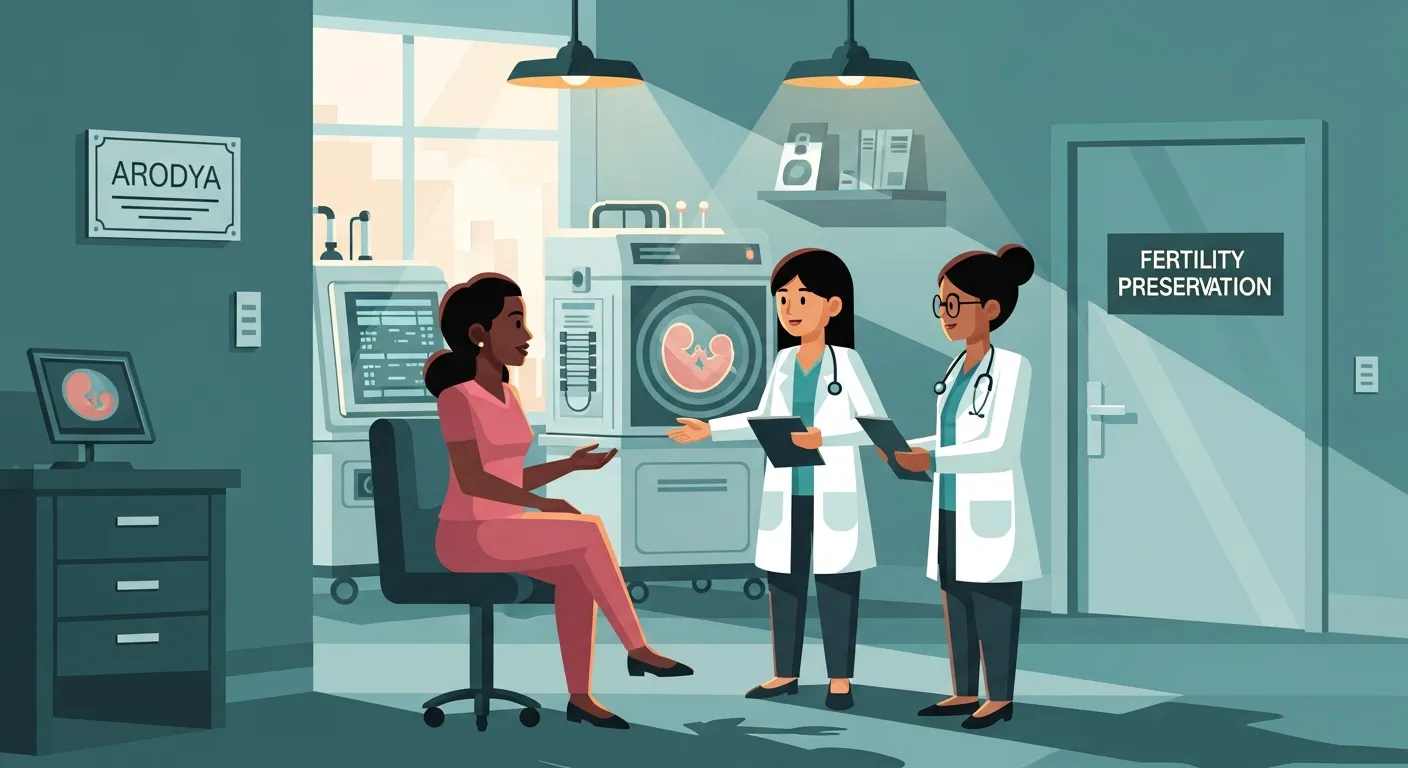
At leading Indian hospitals, this coordination is built into the oncofertility workflow. When a cancer diagnosis is made, the oncologist refers the patient to the reproductive medicine team immediately. Emergency stimulation protocols can compress the timeline when needed.
For international patients, this means acting quickly. If you have received a cancer diagnosis and wish to preserve fertility in India, submitting your case through Arodya's intake form as soon as possible allows the Indian medical team to begin planning while you arrange travel.
Which Indian Hospitals Offer Oncofertility Programmes?
Not every hospital with an IVF centre offers oncofertility. The distinction matters — oncofertility requires active coordination between the oncology department and the reproductive medicine unit, shared treatment planning, and specialists experienced in managing the unique hormonal and timing constraints of cancer patients.
Hospitals with established oncofertility programmes include Apollo Hospitals (Delhi and Chennai), Fortis Memorial Research Institute (Gurgaon), Max Healthcare (Delhi), and Manipal Hospitals (Bengaluru). These centres house both comprehensive cancer units and advanced IVF laboratories within the same campus, enabling same-day referrals and coordinated care.
Cost Comparison: India vs USA vs UK
| Procedure | India (USD) | USA (USD) | UK (GBP) |
|---|---|---|---|
| Sperm banking (per sample) | 300-600 | 1,000-1,500 | 500-800 |
| Egg freezing (per cycle) | 1,500-3,000 | 8,000-15,000 | 4,000-7,000 |
| Embryo freezing (IVF + cryo) | 2,500-4,500 | 12,000-18,000 | 5,000-8,000 |
| Annual storage | 100-300 | 500-1,000 | 200-400 |
These savings mean that fertility preservation — which is often considered a luxury in higher-cost healthcare systems — becomes genuinely accessible when pursued in India.
Moving Forward With Confidence
A cancer diagnosis demands urgent action, and fertility preservation adds another layer of complexity to an already overwhelming situation. But the window to act is narrow, and the regret of not preserving fertility when the option existed is something many cancer survivors describe as lasting.
India's oncofertility centres offer both the expertise and the affordability to make this option real for patients who might otherwise have no access. If you or a family member has been diagnosed with cancer and is considering treatment in India, raising fertility preservation early in the conversation — ideally through your initial enquiry to Arodya — ensures it is factored into the treatment plan from the start. For patients already exploring cancer treatment options in India, adding fertility preservation to the plan is a straightforward addition that the coordinating team can arrange.