Cleft Lip & Palate Repair in India for African Children: Cost & Guide 2026

Cleft Lip & Palate Repair in India for African Children: Cost & Guide 2026
Every 700 births in Africa produces one child with a cleft lip, cleft palate, or both. That is a rate slightly higher than the global average, producing an estimated 30,000 to 40,000 new cases across the continent each year. In many African countries, the gap between supply and demand for paediatric reconstructive surgery means that children wait years — sometimes growing into adults — before they can access the operation that changes their life.
India has built a paediatric plastic surgery infrastructure that is among the most capable in the world. Volume, expertise, and cost converge to make India the most practical destination for African families seeking cleft repair. This guide explains the timing, procedures, costs, and practical logistics for parents considering bringing their child to India for cleft lip and palate surgery.
TL;DR: Complete cleft lip and palate treatment in India costs USD 3,000–5,000 vs USD 15,000–25,000 in the USA. Optimal timing is lip repair at 3–6 months, palate repair at 9–18 months. Older children and adults can also be treated. Top hospitals include Manipal, Apollo, and AIIMS. Medical visa covers the child with one or two parent companions.
The Cleft Lip and Palate Burden in Africa
Cleft lip and palate are among the most common congenital conditions globally. In Africa, several factors compound the burden:
Limited specialist surgical access. Paediatric plastic surgeons trained in craniofacial surgery are concentrated in capital cities, often at a single national referral hospital. Waiting lists can extend two to three years for elective cleft surgery at some centres.
Nutritional challenges. Infants with unrepaired cleft palate cannot breastfeed effectively and are at risk of aspiration and malnutrition. Early repair is not cosmetic — it is critical for feeding, breathing, and developmental health.
Speech and language development. Children with unrepaired cleft palate typically develop hypernasal speech and articulation errors. The later the palate repair, the more intensive the speech therapy required and the less complete the recovery. Early surgical timing is directly correlated with better speech outcomes.
Social stigma. In many African communities, children with visible facial differences face social exclusion that extends to education and family integration. Reconstruction changes not just the child's face but their life trajectory.
Understanding the Cleft Spectrum: Types and What Treatment Involves
Cleft presentations vary significantly in severity:
Cleft lip only (unilateral or bilateral): The lip fails to fuse during fetal development, creating a gap on one or both sides. Unilateral cleft lip is the most common. Treatment involves surgical reunion of the lip tissues using precise techniques to create natural contour.
Cleft palate only: The roof of the mouth fails to fuse, creating an opening that connects the oral and nasal cavities. Palate repair involves bringing the palate tissues together in anatomically correct layers.
Cleft lip and palate combined: The most complex form, requiring staged treatment — lip first, then palate.
Submucous cleft palate: A hidden cleft where the overlying mucosa is intact but the underlying muscle layer has not fused. Often diagnosed later due to hypernasal speech. Requires specialist assessment.
Treatment Timing: Why It Matters
The international consensus on cleft surgery timing is well established:
| Procedure | Optimal Timing | Why This Timing |
|---|---|---|
| Cleft lip repair | 3–6 months | Sufficient weight for anaesthesia; optimal anatomical repair window |
| Cleft palate repair | 9–18 months | Before primary speech development at 18–24 months |
| Nose revision | 4–5 years | Pre-school age; improved nasal form before social exposure |
| Alveolar bone graft | 8–10 years | Before permanent canine tooth eruption |
| Final rhinoplasty | 17–18 years | After facial growth completion |
Indian surgeons treat patients at all stages. For children who missed the optimal window due to lack of access, surgery is still deeply beneficial at any age. Adults with unrepaired cleft lip or palate also undergo successful reconstruction.
Surgical Techniques at Indian Centres
India's paediatric plastic surgeons use internationally standardised techniques:
Millard Rotation-Advancement technique for unilateral cleft lip: the gold standard approach, which rotates the medial segment and advances the lateral segment to create a natural cupid's bow and philtrum. Indian surgeons trained at major craniofacial programmes in Mumbai, Delhi, and Bengaluru perform this at high volume with excellent outcomes.
Bardach two-flap palatoplasty for cleft palate: creates a tension-free repair by advancing large mucoperiosteal flaps. Used at most major Indian centres.
Furlow double-opposing Z-plasty for palate repair: preferred by some surgeons for its superior speech outcomes, particularly for submucous cleft palate.
Primary nose correction at the time of lip repair: most Indian surgeons now incorporate primary nasal correction at the time of lip repair, reducing the need for later revision.
The Cost of Cleft Surgery in India
| Procedure | India | South Africa | USA |
|---|---|---|---|
| Unilateral cleft lip repair | $1,200–2,000 | $3,000–5,000 | $8,000–15,000 |
| Bilateral cleft lip repair | $1,800–2,800 | $4,500–7,000 | $12,000–20,000 |
| Cleft palate repair | $1,500–2,800 | $4,000–7,000 | $10,000–18,000 |
| Combined lip + palate (one stage) | $3,000–5,000 | $7,000–12,000 | $15,000–25,000 |
| Alveolar bone graft | $2,500–4,000 | $5,000–8,000 | $10,000–18,000 |
Costs include anaesthesia, surgeon fees, operating theatre, and a two to three night hospital stay. Speech therapy assessment is typically included in the post-operative follow-up.
Top Hospitals for Paediatric Cleft Surgery in India
Manipal Hospitals (Bengaluru, Dwarka): Dedicated craniofacial and paediatric plastic surgery units with experienced cleft teams. International patient services well established.
Apollo Hospitals (Chennai, Delhi, Hyderabad): Apollo's paediatric surgery departments handle high cleft volumes with comprehensive team approach including orthodontist, speech therapist, and ENT.
AIIMS New Delhi: India's premier government medical institution. The plastic surgery department is one of India's oldest and most experienced cleft programmes. Costs are lower than private hospitals.
Sri Ramachandra Institute, Chennai: Strong paediatric craniofacial programme with dedicated cleft team.
Smile Train Partner Hospitals: Smile Train, the global cleft charity, has partner hospitals across India that provide subsidised or free cleft surgery for eligible patients. Arodya can advise on Smile Train eligibility for families with financial constraints.
The Comprehensive Cleft Team Approach
What distinguishes India's top cleft programmes from standalone surgical interventions is the multidisciplinary team approach. The Cleft Lip and Palate Association of India (CLAPA-India) promotes comprehensive team care that mirrors the best international models. A complete cleft team includes:
- Paediatric plastic surgeon: Performs lip and palate repair
- Orthodontist: Manages dental alignment, arch development, and pre-surgical nasoalveolar moulding (NAM) for infants
- Oral and maxillofacial surgeon: Performs alveolar bone grafting and jaw surgery if required in adolescence
- Paediatric dentist: Manages caries prevention and baby tooth care
- Speech and language pathologist: Assesses and treats velopharyngeal function and articulation
- Ear, Nose, and Throat (ENT) surgeon: Manages hearing loss and Eustachian tube dysfunction (very common in cleft palate children)
- Audiologist: Monitors hearing, which is frequently affected by middle ear problems in cleft palate children
- Psychologist or social worker: Supports the child and family through the treatment journey
For international patients from Africa, the full team may not be accessed in a single India visit — but the treating surgeon typically coordinates which specialist inputs are most critical for the child's current stage and prioritises those during the visit.
Speech Therapy After Cleft Palate Repair
Speech development after palate repair depends on the timing of surgery, the surgical technique, and the quality of post-operative speech therapy. In India:
- Pre-operative speech assessment establishes a baseline
- Post-operative assessment at four to six weeks confirms palatal function
- Speech therapy programme is designed by a licensed speech-language pathologist
- A home programme with exercises is provided for continuation after return
- Guidance for local speech therapists in the home country is included
Velopharyngeal insufficiency (VPI) — where the palate does not fully close against the nasopharynx during speech — can occur despite technically successful surgery and may require secondary palate surgery or a pharyngeal flap procedure. Indian centres have experience managing VPI in international patients.
Understanding Anaesthesia for Infant Cleft Surgery
One of the most anxiety-provoking aspects of cleft surgery for African parents is the prospect of general anaesthesia for a very young infant. Understanding the safety standards Indian paediatric anaesthesiologists work to addresses this concern directly.
Indian hospitals performing cleft surgery on infants use paediatric-specific anaesthetic agents — sevoflurane is standard, avoiding agents with more side effects in infants. Neonatal and paediatric anaesthesia teams have specific training in infant airway management, temperature maintenance, fluid management, and post-anaesthetic recovery for young children.
Pre-operative fasting times follow international guidelines — breast milk can be given up to two to four hours before, formula up to four hours before. The anaesthesiologist meets the family before surgery, discusses the child's health status, and answers all questions. For parents whose infants have never had surgery, this consultation is particularly important.
After surgery, infants are monitored in a paediatric recovery unit before returning to their room. Elbow restraints are placed to prevent the child from touching the repair during healing. Pain management uses paediatric-appropriate agents and dosing. Most infants recover from cleft lip surgery remarkably quickly — feeding (via special cleft spoons or bottles) typically resumes within 24 hours.
For parents concerned about their child's first surgical experience in a foreign country, Arodya arranges hospital visits before admission so families see the paediatric unit and meet the nursing team before the operation day.
Planning Your Child's Surgery with Arodya
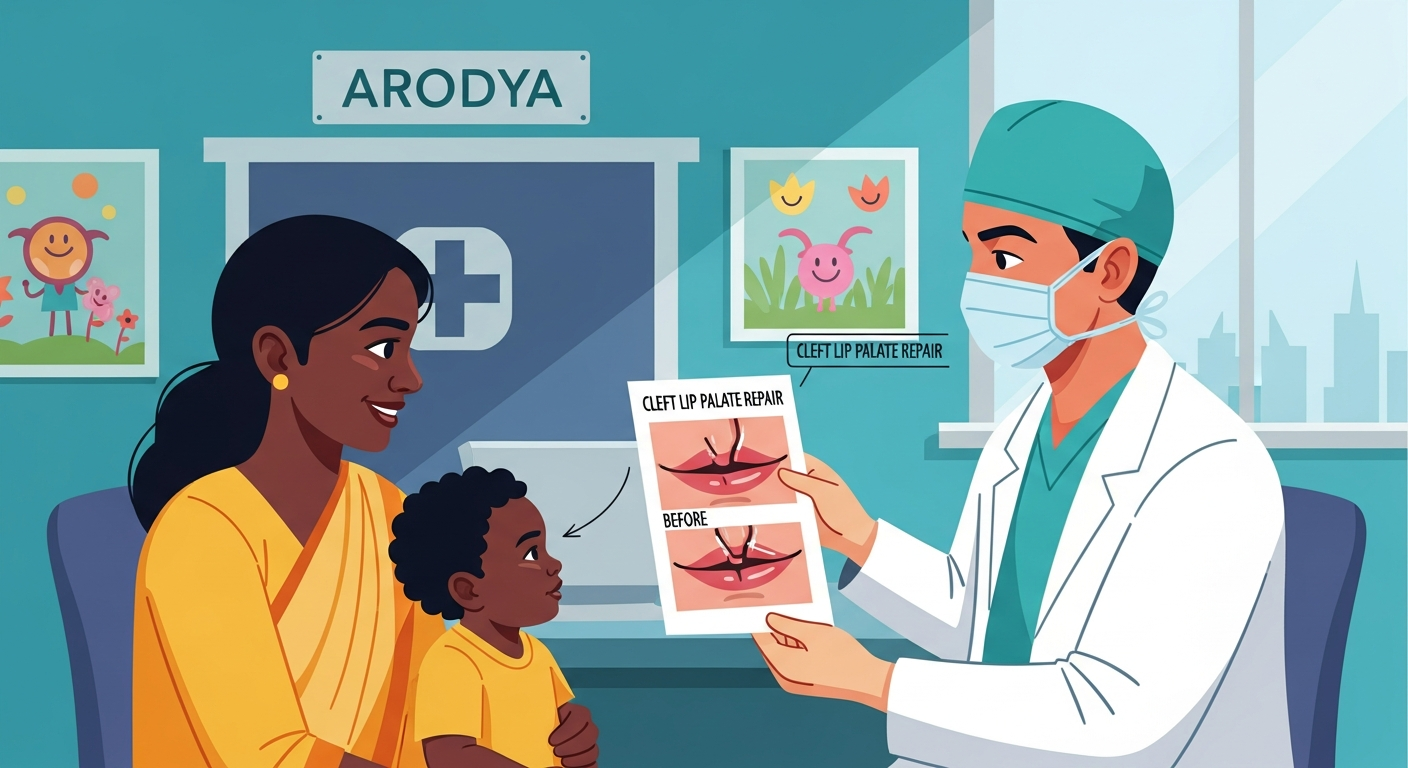
Submit your child's case for a free review — share photographs (frontal and profile), any prior medical records, and information about the child's age, current feeding ability, and speech development. An Indian paediatric plastic surgeon assesses the case and recommends the appropriate treatment plan and timing.
Arodya coordinates the child's medical visa application with parent companion visas, airport transfers, accommodation near the paediatric surgical unit, and post-operative follow-up planning. For families concerned about their child's first anaesthetic experience abroad, we work with hospitals that have dedicated paediatric anaesthesia teams experienced with international children.
Every child deserves the face they were born to have. Learn more about preparing for your child's first trip to India for treatment and take the first step. The surgery that changes your child's life may be more accessible than you think.