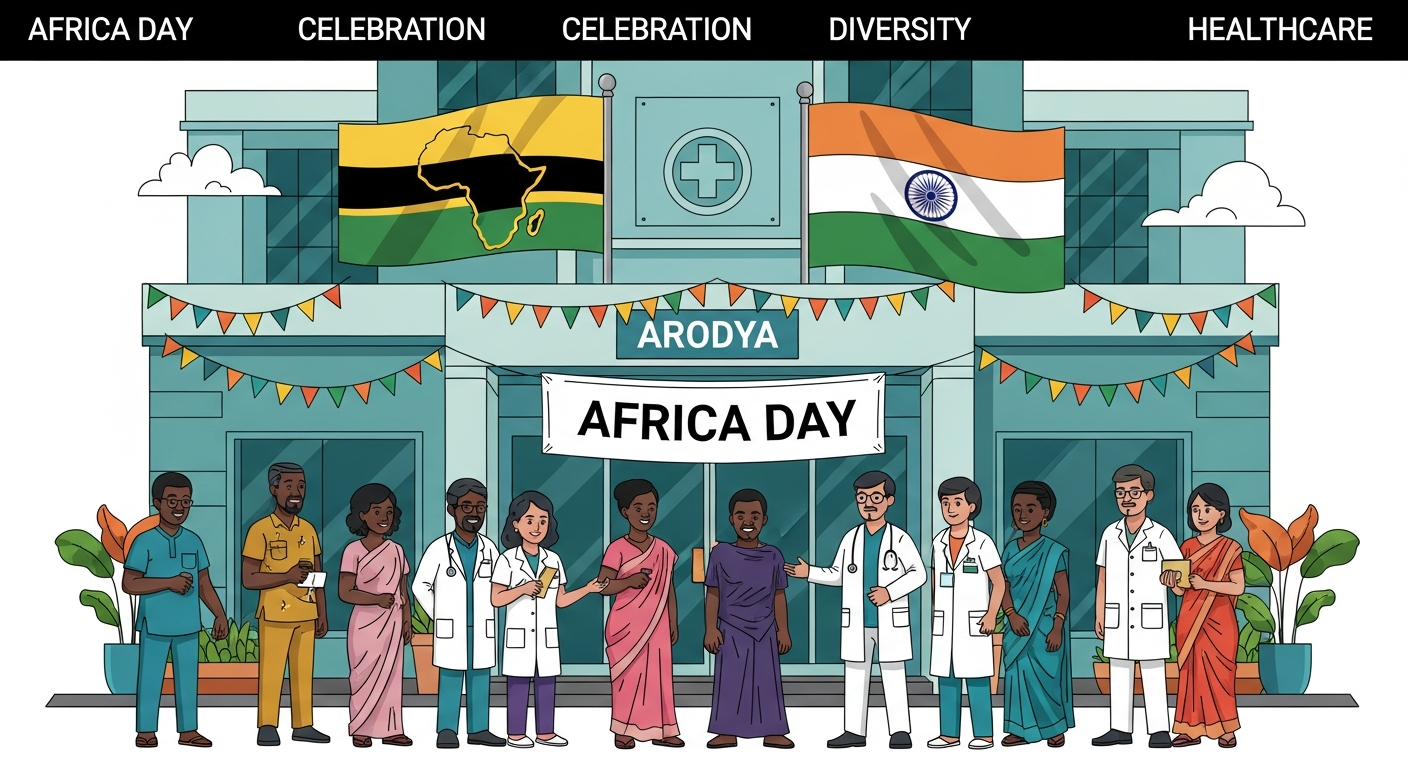
Africa Day 2026: Every African Nation's Path to World-Class Healthcare in India

Africa - India Health Correspondent

Africa Day 2026: Every African Nation's Path to World-Class Healthcare in India
On May 25, 1963, the founders of the Organisation of African Unity gathered in Addis Ababa and made a declaration that would shape a continent: Africa stands together. This Africa Day 2026, that principle finds one of its most powerful expressions in healthcare. Across all 54 African nations - from Egypt in the north to South Africa in the south, from Senegal in the west to Somalia in the east - patients are finding their path to world-class treatment in India.
This guide maps those pathways region by region. Whether you are reading from Lagos, Nairobi, Cairo, Kinshasa, or Johannesburg, there is a route to India's hospitals - and Arodya is here to navigate it with you.
Why India Serves All of Africa
Before exploring regional specifics, it is worth understanding why India has become the healthcare partner for the entire African continent, not just a handful of nations.
India's private hospital sector has built systematic international patient infrastructure over two decades. The major hospital groups - Apollo, Fortis, Max, Medanta, Manipal - each operate international patient departments serving more than 30 nationalities. Their clinical teams are accustomed to treating patients whose home country context differs radically from India's own. Their support staff speak Arabic, French, Swahili, Hausa, and English alongside Hindi.
Cost is a persistent, powerful draw. A cardiac bypass surgery that costs $100,000-150,000 in the USA or Europe costs $7,000-12,000 in India - with equivalent or superior clinical outcomes. For patients from any of Africa's 54 nations, the arithmetic is compelling.
North Africa: Egypt, Libya, Morocco, Tunisia, Sudan, Algeria
North African nations have well-established medical tourism ecosystems of their own, but India occupies a specific niche: complex procedures that North African facilities do not yet routinely offer at the highest levels, and cost savings even against North African private sector prices.
Key connection points:
- Egypt: Air India operates direct flights between Cairo and Delhi. Egyptian patients - particularly for cardiac and oncology care - are a significant presence at Delhi and Mumbai hospitals.
- Libya: Despite political instability complicating travel, Libyan patients access India via Cairo or Tunis. Arabic-speaking patient coordinators are essential.
- Morocco: Casablanca connects to Delhi via Gulf carriers. Morocco has a growing number of patients seeking advanced spinal procedures and oncology.
- Sudan: Khartoum to Delhi via Addis Ababa or Dubai. Sudanese patients are among the most significant North African cohorts in Indian hospitals.
Language: Arabic is the primary language. Major Indian hospitals serving North African patients have Arabic interpreters and coordinators.
Common procedures: Cardiac surgery, oncology (particularly haematological cancers), orthopaedics, neurosurgery.
West Africa: Nigeria, Ghana, Senegal, Ivory Coast, Sierra Leone, Liberia, Cameroon
West Africa - home to Africa's most populous nation, Nigeria - is by far the largest regional source of African medical tourists to India.
Nigeria alone sends an estimated 200,000 patients annually. The Nigerian medical tourism community in India is visible, organised, and experienced. Nigerian patient associations in cities like Delhi provide invaluable peer support to new arrivals. Arodya's West African network is the most developed of any African regional corridor.
Key connection points:
- Nigeria: Lagos connects to Delhi via Air India direct, Emirates (via Dubai), Ethiopian Airlines (via Addis), and Qatar Airways (via Doha). Abuja also has connections via Gulf hubs.
- Ghana: Accra connects to Delhi via Emirates, Ethiopian Airlines, and Kenya Airways (via Nairobi). Direct Air India services have been discussed.
- Senegal/Ivory Coast: Francophone nations connecting via Paris CDG, Brussels, or Gulf hubs. French-speaking coordination is essential.
- Cameroon: Yaoundé or Douala via Paris or Gulf hubs. French and English (in English-speaking regions) support needed.
Language: English (Nigeria, Ghana, Sierra Leone, Liberia), French (Senegal, Ivory Coast, Cameroon, Burkina Faso). Both major Indian hospital groups provide both.
Common procedures: Cardiac surgery, kidney transplant, orthopaedics, neurosurgery, oncology, liver transplant.
East Africa: Kenya, Tanzania, Ethiopia, Uganda, Rwanda, Somalia, Eritrea
East Africa has perhaps the deepest institutional relationship with Indian healthcare. Kenya and Tanzania have bilateral health agreements with India. Ethiopian Airlines is the continent's primary carrier to India and has made the Addis Ababa hub a gateway for patients from across the Horn of Africa and beyond.
Key connection points:
- Kenya: Nairobi to Mumbai direct (Kenya Airways) or via Dubai/Addis. Kenya has strong bilateral health cooperation with India.
- Tanzania: Dar es Salaam via Addis Ababa (Ethiopian) or Dubai. Tanzanian patients are among the most regular visitors to Chennai and Bangalore hospitals.
- Ethiopia: Addis Ababa to Delhi/Mumbai direct on Ethiopian Airlines - the best single air connection on the continent.
- Uganda: Entebbe via Nairobi or Addis. Growing rapidly as a source market, particularly for cardiac and oncology.
- Rwanda: Kigali via Addis Ababa. Rwanda's growing middle class is increasingly health-conscious and globally oriented.
- Somalia: Mogadishu via Addis or Dubai. Despite access challenges, Somali patients are a significant cohort, particularly for complex trauma and cardiac care.
Language: Swahili, English, Amharic, Somali. Indian hospitals' East African services are often staffed by Kenyan and Tanzanian nationals who bring both linguistic and cultural fluency.
Common procedures: Cardiac surgery (particularly valve surgery), kidney transplant, cancer treatment, orthopaedics, neurosurgery.
Central Africa: DRC Congo, Republic of Congo, Gabon, Equatorial Guinea, Central African Republic, Chad
Central Africa is the most logistically challenged region for India-bound medical tourism, but the healthcare access gap is often the most acute. The Democratic Republic of Congo, with 100 million people and a healthcare system severely limited by decades of conflict, has a particularly significant demand for external treatment.
Key connection points:
- DRC (Congo): Kinshasa to Delhi via Addis Ababa (Ethiopian) or Brussels/Gulf hubs. French-speaking coordination is essential. Arodya has developed Kinshasa-specific pathways.
- Republic of Congo: Brazzaville via Paris or Addis. Smaller but growing patient base.
- Gabon: Libreville via Paris or Addis. Gabon's oil wealth creates a cohort of patients who can afford premium care.
Language: Primarily French. Some Congolese patients from the eastern provinces may communicate in Swahili as well.
Challenges and solutions: Currency access can be complex in Central Africa. USD wire transfers are the standard mechanism. Arodya assists with payment planning.
Common procedures: Oncology, cardiac surgery, complex orthopaedics.
Southern Africa: South Africa, Zimbabwe, Zambia, Mozambique, Botswana, Namibia, Madagascar, Comoros
Southern Africa presents a diverse picture. South Africa has a substantial private hospital sector of its own - patients from South Africa typically seek care in India for procedures where cost savings are compelling even against South African private sector pricing, or where waiting lists in South Africa are prohibitive.
Zimbabwe, Zambia, and Mozambique have more limited specialist capacity and India fills a critical gap.
Key connection points:
- Zimbabwe: Harare to Delhi via Addis Ababa, Dubai, or Nairobi. Zimbabwe is a rapidly growing source market.
- Zambia: Lusaka via Addis or Nairobi. Strong growth in cardiac and oncology patients.
- South Africa: Johannesburg direct connections to Mumbai and Delhi. SA patients with medical scheme coverage sometimes include India treatment provisions.
- Mozambique: Maputo via Addis, Johannesburg, or Nairobi. Portuguese-speaking; hospitals need Portuguese interpreter services.
- Madagascar and Comoros: Indian Ocean island nations with very limited specialist care; see our dedicated guide.
Language: English, Shona, Ndebele, Zulu, Portuguese (Mozambique), French/Malagasy (Madagascar).
Common procedures: Cardiac surgery, oncology, spinal surgery, orthopaedics.
What Every African Patient Shares
Despite the enormous diversity across Africa's 54 nations, patients who come to India share a common experience: they arrive worried, they find care that often exceeds their expectations, and they return with stories that bring the next patient.
The Africa-India healthcare relationship has grown through this word-of-mouth recommendation chain for three decades. It works because Indian hospitals deliver clinical outcomes that match or exceed anything available in the West, at prices that make treatment accessible rather than aspirational.
This Africa Day, if you are considering treatment in India from anywhere on the continent, start your consultation with Arodya. Our coordinators know the specific pathways from your country, speak your language, and have guided patients from all 54 African nations.
A United Africa, Accessing United Care
The vision of Africa Day - continental unity, shared dignity, collective progress - is expressed in healthcare every time an African patient accesses treatment they need. India is honoured to be a part of that story.
Whether you are in Lagos or Lusaka, Cairo or Kampala, Dakar or Dar es Salaam - there is a path to world-class care. Let Arodya walk it with you.