Scoliosis Surgery in India for Children and Adults: Cost, Outcomes & Guide 2026
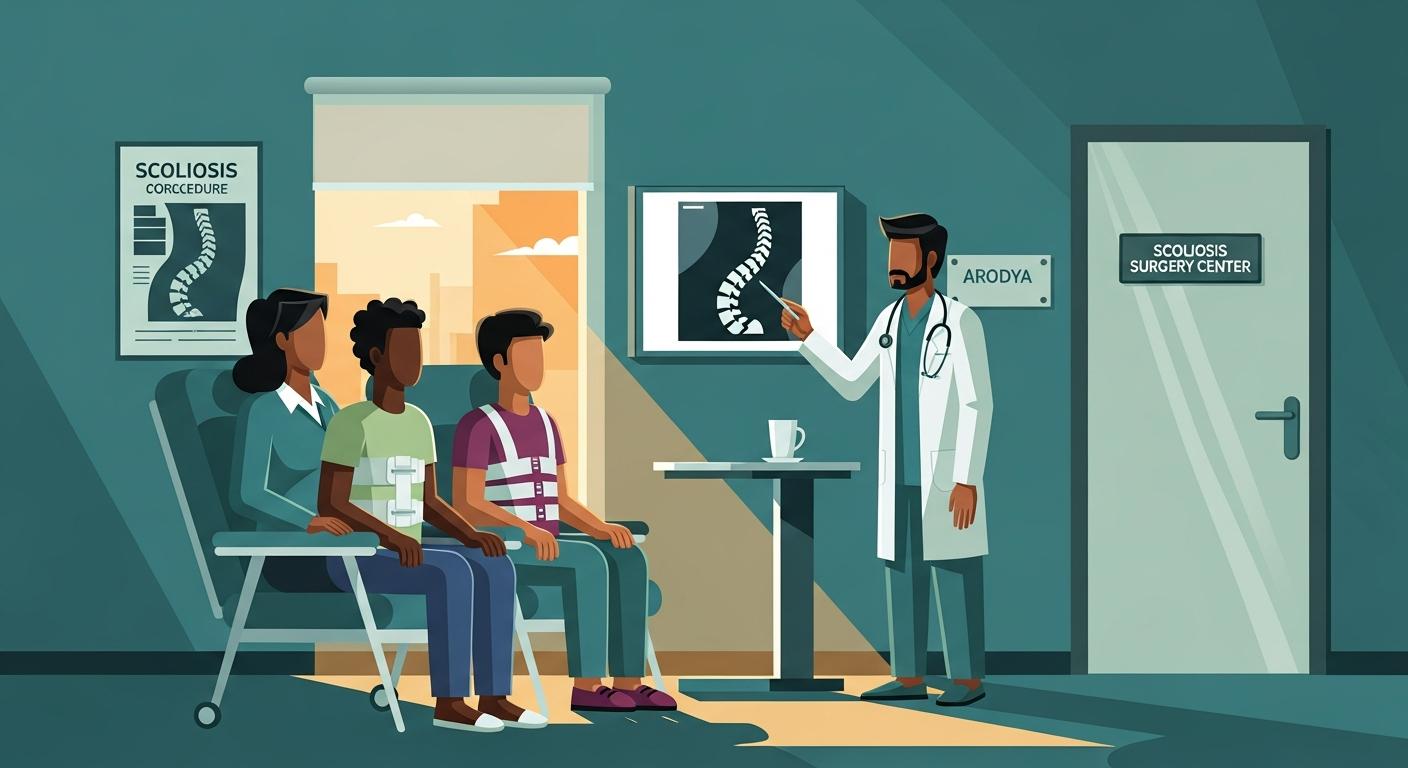

A curved spine that goes untreated doesn't stay curved — it progresses. For children and adolescents with scoliosis, every degree of Cobb angle increase before skeletal maturity makes future surgery more complex. For adults, advancing curvature erodes quality of life, compresses nerves, and eventually threatens lung function. India's spinal surgery centres have become a serious option for families across Africa who want definitive treatment without the USD 60,000–120,000 costs seen at Western hospitals.
TL;DR: Scoliosis spinal fusion costs USD 6,000–12,000 in India, and growing rod surgery for young children runs USD 8,000–14,000 — compared to USD 50,000–100,000 in the USA (Patients Beyond Borders, 2024). India's top spine centres use O-arm intraoperative imaging and neuromonitoring for all deformity corrections, with complication rates within published international benchmarks.
When Is Surgery Actually Necessary?
Not every scoliosis patient needs surgery. Indian orthopaedic surgeons follow the same evidence-based thresholds used internationally. Surgery is typically recommended when the Cobb angle exceeds 45–50 degrees in skeletally immature patients, or 50–55 degrees in adults (Journal of Bone and Joint Surgery, 2023). Below these thresholds, bracing is usually the first intervention for growing patients.
Several factors accelerate the decision toward surgery:
- Rapid progression — curves increasing by 5 or more degrees over 6 months despite bracing
- Respiratory compromise — thoracic curves above 60–70 degrees reduce vital capacity
- Pain unresponsive to conservative management — particularly in adult degenerative scoliosis
- Neurological symptoms — leg weakness, numbness, or bladder dysfunction from nerve compression
If you arrive in India with an existing brace prescription and curves in the 30–45 degree range, the Indian spine surgeon will likely recommend continuing bracing and monitoring rather than jumping to surgery.
Surgical Options Available in India
Posterior spinal fusion (PSF)
The standard approach for adolescent idiopathic scoliosis (AIS). Pedicle screws are placed above and below the curve, and rods connect them to gradually correct the deformity. The fused vertebrae grow together permanently. India's spine centres use titanium implants with established track records. Neuromonitoring (SSEP and MEP) is used throughout to protect the spinal cord.
Anterior spinal fusion (ASF)
Used selectively for thoracolumbar and lumbar curves in adolescents. Approached from the side of the body, it achieves correction with fewer fused levels than posterior fusion, preserving more spinal mobility. Available at dedicated spinal centres at Medanta, Apollo, and Kokilaben.
Growing rod constructs (for young children)
For children under 8 or 10 with severe progressive curves, growth-preserving surgery uses expandable rods anchored at the top and bottom of the spine. The rods are lengthened periodically (every 6–12 months) as the child grows, delaying fusion until the spine and lungs have matured. Magnetically controlled growing rods (MCGR) allow lengthening without additional surgery — now available at major Indian centres.
Vertebral body tethering (VBT)
A newer, motion-preserving technique for adolescents with flexible curves, implanting a cord on the convex side to guide corrective growth. Available at select Indian centres for appropriately selected patients who are still growing.
For a broader overview of minimally invasive spine approaches, see our guide to minimally invasive spine surgery in India.
Cost of Scoliosis Surgery in India
The cost differential versus Western care is substantial.
| Procedure | India (USD) | USA (USD) | UK Private |
|---|---|---|---|
| Posterior spinal fusion (10–14 levels) | 6,000 – 10,000 | 50,000 – 100,000 | £30,000 – £65,000 |
| Growing rod insertion (initial) | 8,000 – 14,000 | 50,000 – 90,000 | £35,000 – £70,000 |
| MCGR rod lengthening (per session) | 2,000 – 4,000 | 15,000 – 30,000 | £8,000 – £15,000 |
| Revision deformity correction | 10,000 – 18,000 | 70,000 – 150,000 | £45,000 – £90,000 |
Sources: Patients Beyond Borders 2024; hospital quotes collected by Arodya, 2025.
These figures include surgeon's fee, anaesthesia, implants, neuromonitoring, ICU stay, and standard ward days. The implant cost (titanium rods and pedicle screws) accounts for 30–40% of the total.
Which Hospitals Lead in Scoliosis Surgery?
Medanta The Medicity, Gurgaon has one of India's most active spinal deformity programmes, with dedicated fellowship-trained deformity surgeons and O-arm intraoperative CT capabilities. Apollo Hospitals Delhi and Kokilaben Dhirubhai Ambani Hospital Mumbai both have established paediatric and adult scoliosis surgery programmes. AIIMS Delhi handles complex and revision cases and is where many Indian surgeons train.
When evaluating a centre, ask: How many scoliosis fusions did you perform last year? Do you use intraoperative neuromonitoring? What is your approach to blood conservation? High-volume centres performing 100+ deformity corrections annually have better outcomes than those doing 20.
For orthopaedic context more broadly, see our guide to neurosurgery and spine surgery in India.
What to Expect Before, During, and After Surgery
Pre-operative assessment (1–2 days): Full-length standing X-rays, flexibility films, MRI (for neural element assessment), pulmonary function testing (for thoracic curves), and blood work. All required before surgical planning.
Surgery duration: Posterior spinal fusion typically takes 3–5 hours under general anaesthesia. Growing rod procedures take 2–3 hours.
Hospital stay: 5–8 days. ICU for the first 1–2 nights, step-down ward thereafter.
Post-discharge in India: Most surgeons want to see patients at 1 week and 2 weeks post-operatively before clearing for long-haul flight. Plan for 4–6 weeks total in India.
At home: No heavy lifting, bending, or twisting for 3–6 months. Return to school or light work typically at 6–8 weeks. Contact sport clearance at 9–12 months following solid fusion.
Starting Your Scoliosis Journey
The most important document to bring to India is a recent set of full-length standing scoliosis X-rays (posterior-anterior and lateral, 36-inch cassette, weight-bearing). If you don't have these, they'll be taken on arrival, but having them speeds planning considerably.
Submit your child's or your own case to Arodya with the X-ray images and any MRI reports. We'll get proposals from two or three appropriate Indian spine centres within a week.