

Kidney Transplant in India: Your Complete Guide to World-Class Transplantation

Healthcare Economics & Cost Analyst

TL;DR: Kidney transplant in India costs USD 13,000–20,000 - 60–70% less than the USA or Gulf hospitals. India's transplant success rate (90–95% graft survival at 1 year for living donor) matches international benchmarks. Living donor transplant is legal for first-degree relatives; deceased donor wait times run 1–3 years. Processing time from enquiry to surgery: 4–8 weeks. (NOTTO India, 2023)
Chronic kidney disease affects more than 850 million people globally - and in sub-Saharan Africa, over 50% of cases go undiagnosed until dialysis is unavoidable. (International Society of Nephrology, 2022). Transplantation offers far better long-term survival than dialysis, but costs in the USA exceed USD 260,000. India performs over 4,000 kidney transplants annually at 13,000–20,000 USD, with 1-year graft survival of 90–95% for living donor procedures. This guide explains the process, costs, and practical steps for patients travelling from Africa.
Why Choose Kidney Transplant in India?
How Do Costs Compare?
Kidney transplantation in India costs 60–75% less than in the USA or UK. (Medical Tourism Association, 2023). A complete package - surgery, hospitalisation, investigations, and the first month of follow-up - runs USD 13,000–20,000 in India versus USD 260,000–300,000 in the USA.
Citation capsule: Kidney transplant in India costs USD 13,000–20,000 for a complete package - compared to USD 260,000–300,000 in the United States, according to the Medical Tourism Association (2023). India's leading transplant centres report 1-year living donor graft survival of 90–95%, consistent with ISHLT Registry data from North American and European centres.
Cost Comparison:
| Component | USA | UK | India |
|---|---|---|---|
| Transplant surgery | $150,000–200,000 | £80,000–120,000 | $10,000–15,000 |
| Hospital stay (1–2 weeks) | $30,000–50,000 | £20,000–40,000 | $2,000–4,000 |
| Immunosuppression (year 1) | $20,000–40,000 | £15,000–30,000 | $3,000–6,000 |
| Total comprehensive package | $260,000–300,000 | £150,000–200,000 | $13,000–20,000 |
World-Class Transplant Centres
India's leading kidney transplant centres offer:
Diagnostic Equipment:
- High-resolution ultrasound and CT angiography for donor kidney evaluation
- Automated HLA typing and flow cytometry crossmatching
- 24/7 transplant laboratory services
- Advanced immunological monitoring (DSA, PRA testing)
Surgical Capabilities: Living donor laparoscopic nephrectomy, paired kidney exchange, desensitisation protocols for highly sensitised recipients, paediatric transplantation.
Accreditation: JCI international certification, NABH, ISO quality management. Centres at Apollo, Fortis, Manipal, and Medanta maintain active transplant programmes with 200+ procedures annually.
Expert Transplant Teams
India's nephrologists and transplant surgeons hold MD or DM qualifications with international fellowship training. Most have 15–25 years of transplant experience, have completed thousands of procedures, and follow KDIGO (Kidney Disease: Improving Global Outcomes) guidelines.
Understanding Kidney Failure and Transplantation
What is End-Stage Kidney Disease?
Chronic kidney disease progresses through five stages as kidney function declines. Stage 5 - end-stage kidney disease (ESKD) - is reached when the estimated glomerular filtration rate (eGFR) falls below 15 mL/min/1.73m². At this point, renal replacement therapy is required: dialysis or transplantation. Transplantation consistently outperforms dialysis for survival, quality of life, and cardiovascular outcomes.
Who Needs a Kidney Transplant?
Transplant candidacy applies to patients with eGFR below 15 mL/min/1.73m², patients already on dialysis, and patients who are pre-emptively listed before reaching end-stage disease. Age alone does not exclude candidates - Indian centres transplant patients aged 6 months to 75+. Key contraindications include active malignancy, uncontrolled infection, and fixed pulmonary hypertension.
Arodya Data
Types of Kidney Transplants Available in India
Deceased Donor Transplant
A kidney from a brain-dead donor is transplanted following ethical approval and national allocation criteria. India's deceased donor programme is managed by NOTTO (National Organ and Tissue Transplant Organisation), which maintains a transparent waiting list. Blood group, urgency status, and HLA matching determine allocation. International patients are listed but typically wait longer than resident patients for deceased donor organs.
5-year graft survival: 80–85%. Wait time: 1–3 years (varies by blood group and centre).
Living Donor Transplant
Living donor transplant is India's most common kidney transplant pathway. A healthy related donor (parent, sibling, child, spouse) donates one kidney. The procedure is legal for emotionally related donors (spouses, close friends) with approval from an authorisation committee.
5-year graft survival: 90–95%. Surgery can be scheduled within 4–8 weeks of arrival.
Laparoscopic donor nephrectomy minimises donor recovery time - most donors return home within 3–5 days. Extensive long-term data confirms that living with one kidney causes no significant reduction in life expectancy.
Paired Kidney Exchange
If a willing donor is incompatible with the intended recipient, a paired kidney exchange matches incompatible pairs so that each recipient receives a compatible kidney from a different donor. India's paired exchange programmes operate at major transplant centres and have expanded access for blood group or HLA-incompatible pairs.
The Kidney Transplant Procedure
Pre-Transplant Evaluation
Recipient Assessment:
- Complete blood count, renal function panel, liver function, coagulation
- Cardiovascular evaluation (ECG, echocardiography, stress test if indicated)
- Infectious disease screening (HIV, Hepatitis B and C, CMV, EBV, TB, syphilis)
- Cancer screening (age-dependent - colonoscopy, mammography)
- HLA typing and panel reactive antibody (PRA) testing
Donor Assessment:
- Complete medical evaluation - physical examination, blood tests, urine tests
- Renal imaging: CT angiography to assess kidney anatomy and vascularity
- Psychological evaluation and ethical clearance
- Independent advocacy to confirm absence of coercion
Surgical Procedure
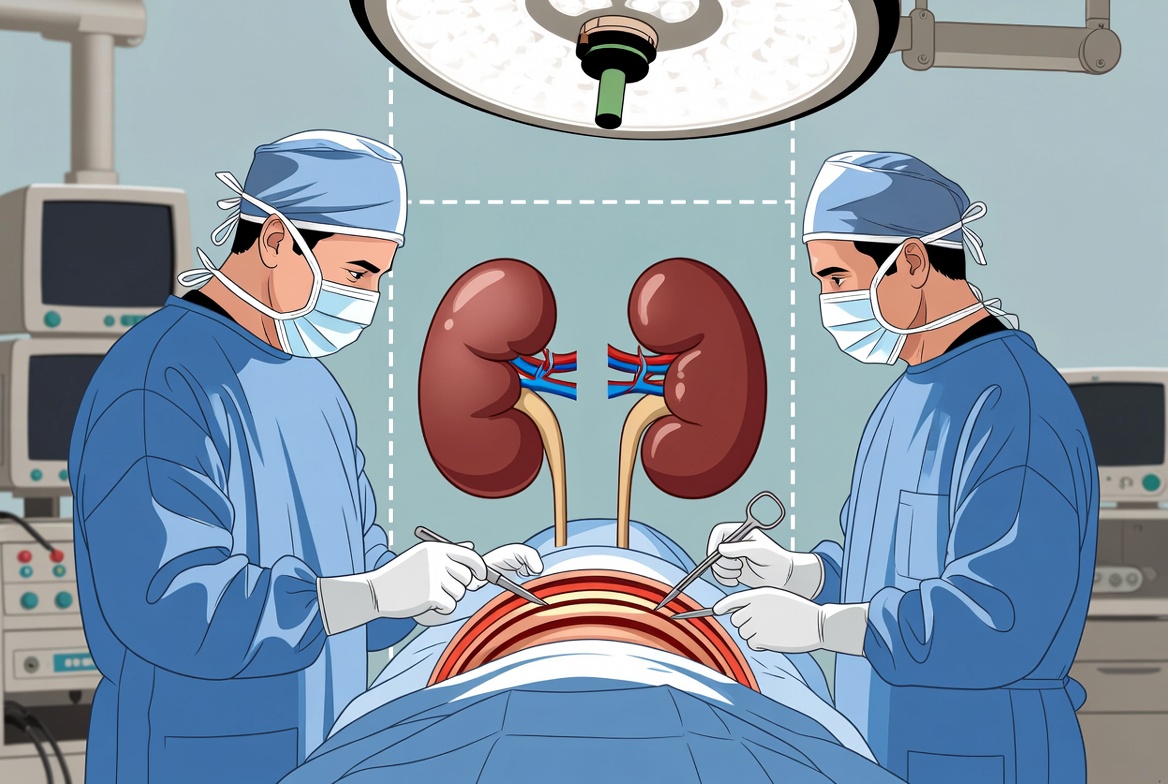
The surgery takes 2–3 hours under general anaesthesia. The donor kidney is placed in the recipient's lower abdomen (the native kidneys are usually left in place unless infected or causing complications). The renal artery, renal vein, and ureter are anastomosed to the recipient's iliac vessels and bladder. Hospital stay: 5–7 days for uncomplicated living donor cases.
Post-Transplant Management
First Week:
Close monitoring of kidney function, urine output, blood pressure, and immunosuppression drug levels. Catheter removal at day 3–5. Most patients achieve immediate graft function.
First Month:
Two to three outpatient visits per week. Blood tests at each visit. Medication dose adjustments based on tacrolimus levels. Activity restrictions are gradually lifted - most patients walk independently within 48 hours.
First Year:
Monthly clinic visits, continued medication adjustment, annual cardiovascular review, and complication screening (diabetes, bone disease, malignancy). Most patients return to full activity within 8–12 weeks.
Immunosuppression After Kidney Transplant
Standard Maintenance Regimen
India's transplant centres use triple-therapy immunosuppression consistent with KDIGO guidelines:
- Calcineurin inhibitor (tacrolimus, preferred over cyclosporine): Prevents T-cell activation. Requires therapeutic drug monitoring.
- Antimetabolite (mycophenolate mofetil): Inhibits lymphocyte proliferation. Reduces acute rejection episodes.
- Corticosteroid (prednisolone): Dose-reduced over 3–6 months in most protocols.
Rejection Types and Management
Acute cellular rejection occurs in 10–15% of transplants in the first year. It responds well to high-dose corticosteroid pulses in most cases. Antibody-mediated rejection is less common but harder to treat - managed with plasmapheresis and IV immunoglobulin. Both are detected early through regular kidney function testing and protocol biopsy where indicated.
Long-Term Kidney Transplant Outcomes
Graft Survival Rates in India
| Transplant Type | 1-Year | 5-Year | 10-Year |
|---|---|---|---|
| Living donor | 95–97% | 90–95% | 70–80% |
| Deceased donor | 90–93% | 80–85% | 60–65% |
These outcomes are consistent with ISHLT Registry data from North American and European centres. (ISHLT Registry, 2022).
Kidney Transplant vs Dialysis
Compared to long-term haemodialysis:
- Life expectancy: 10–15 years longer with transplant
- Cardiovascular mortality: 50–60% lower
- No dialysis schedule constraints (3 sessions/week on dialysis)
- Fewer dietary restrictions
- Return to work: possible within 8–12 weeks
: The survival benefit of transplant over dialysis is actually larger in younger patients and in patients from low- and middle-income countries - where dialysis infrastructure is limited, home dialysis is rarely available, and the logistical and financial burden of 3-times-weekly treatment is severe. For patients from Africa, this makes the case for transplant even stronger than the headline survival statistics suggest.


