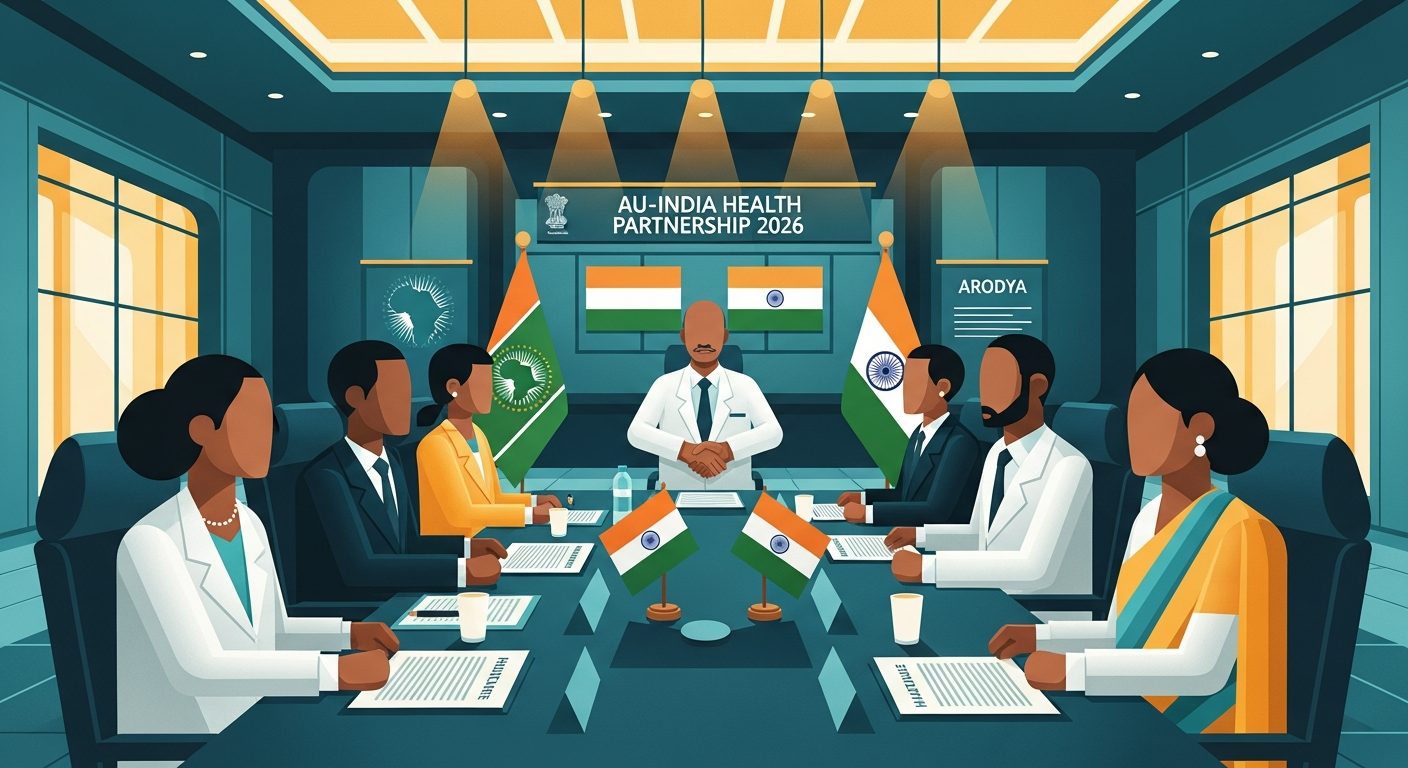
African Union Health Agenda 2063 & India's Partnership Role in 2026

Healthcare Economics & Cost Analyst

African Union Health Agenda 2063 & India's Partnership Role in 2026
The day after Africa Day is rarely given the attention it deserves in healthcare conversations. But May 26 is precisely the moment to examine what Africa Day's celebrations mean in policy terms - to move from commemorating the Africa-India solidarity to understanding how that solidarity is being institutionalised, funded, and delivered through the African Union's most ambitious development framework.
Agenda 2063 - "The Africa We Want" - is the African Union's blueprint for continental transformation over fifty years. Its health commitments are not slogans. They are measurable targets with specific deadlines. And understanding them explains why India has become not just a preferred destination for African patients, but a strategic partner in the AU's own development architecture.
What Agenda 2063 Says About Health
The African Union's Agenda 2063 was adopted in 2015 as the continent's overarching development strategy. Its health dimension is captured primarily in the Africa Health Strategy 2016-2030, which operationalises Agenda 2063's health goals into specific, time-bound targets.
Key health targets under AU Agenda 2063:
- Universal health coverage (UHC) across all 55 AU member states by 2030
- Maternal mortality below 70 per 100,000 live births by 2030 (from current continental average of ~450)
- Elimination of HIV/AIDS, malaria, and tuberculosis as public health threats
- 50% reduction in non-communicable disease (NCD) mortality by 2030
- Sufficient specialist capacity on the continent to end health tourism as a necessity
That final target is perhaps the most honest and most ambitious: the explicit goal of building Africa's healthcare capacity to the point where Africans no longer need to travel abroad for specialist care. It is a target that, if achieved, would eventually make Arodya's core business unnecessary. We support that goal completely - while serving the millions of patients who need care before it is achieved.
Where Africa Stands in 2026 Against Agenda 2063 Targets
Progress toward the Agenda 2063 health targets is real but uneven. A frank assessment for 2026:
Universal health coverage: Progress is significant in Rwanda (85% coverage), South Africa, and Morocco. But the continental average remains below 50%. Nigeria, the continent's largest economy, has approximately 5% effective health coverage for specialist care. The target is mathematically unreachable by 2030 without dramatic acceleration.
Maternal mortality: Has declined significantly in East Africa but remains catastrophically high in West and Central Africa. The 2030 target requires a pace of reduction that most nations are not currently achieving.
NCD mortality reduction: This is where the gap is most acute. Africa's NCD burden - cardiac disease, diabetes, cancer, chronic respiratory disease - is growing rapidly as diets urbanise and populations age. But the specialist capacity to treat NCDs remains woefully inadequate. Cancer, cardiac disease, kidney failure, and diabetes complications are the leading drivers of African medical tourism to India.
Specialist capacity: Significant hospital construction and medical school expansion is occurring across the continent. But training specialists takes a decade from medical school entry to fellowship completion. Even if every medical school in Africa doubled its output tomorrow, the specialist capacity gap would not close for twenty years.
India's Role in the AU Framework: IAFS and Beyond
India's engagement with the African Union's health agenda is formalised through multiple mechanisms, most importantly the India-Africa Forum Summit (IAFS).
The third IAFS in 2015 - attended by 54 African heads of state in New Delhi - generated the most comprehensive package of India-Africa cooperation commitments in history. The health component included:
| Commitment | Detail |
|---|---|
| Health worker training | 50,000 African health professionals trained in India by 2030 |
| Medical professionals | 600 Indian doctors and health workers deployed to Africa |
| Generic medicines | Jan Aushadhi stores and essential medicine supply in partner countries |
| Telemedicine | eSanjeevani platform for free specialist consultations |
| Hospital projects | India-supported hospitals in Ethiopia, Tanzania, Kenya, Mozambique, Zambia |
| Medical education | Reserved postgraduate training seats for African students |
The total IAFS 2015 package was valued at $600 million in lines of credit and grants - with health commitments forming a substantial component.
A fourth IAFS is being prepared, expected to substantially expand these commitments. The AU's health agenda provides the institutional demand that makes expanded IAFS health cooperation politically viable on both sides.
The Economics of AU-India Health Cooperation
Understanding the economic dimension of AU-India health cooperation helps patients understand why both governments have an interest in maintaining and expanding it.
For African governments: Medical tourism is economically painful - it represents foreign exchange outflow that could be retained domestically if specialist capacity existed. But building that capacity requires decades. In the interim, ensuring citizens can access affordable international care - rather than being denied treatment - is politically and morally essential. India's affordable pricing minimises the foreign exchange cost of necessary health travel.
For India: The Africa-India medical tourism corridor generates over $2 billion annually in healthcare exports. This supports Indian hospital employment, pharmaceutical sales, and medical training industries. India has a systemic economic interest in the relationship's health. This economic interest ensures that India continues investing in the relationship's quality - language services, cultural accommodation, patient support - rather than taking African patients for granted.
For patients: The intersection of these interests creates a market that works in patients' favour. African patients are valued customers of Indian hospitals. Their feedback drives improvement. Their satisfaction generates referrals. This commercial dynamic ensures standards remain high.
What the AU Framework Means for Individual Patients
For a patient from Nigeria or Kenya sitting in an Arodya consultation, the AU's Agenda 2063 may seem abstract. But it has concrete practical implications.
Medical visa processing: India's medical visa category exists in part because of diplomatic pressure from AU member states who argued that health travel should have dedicated facilitation. Countries with bilateral health agreements - Kenya, Tanzania, Ethiopia - benefit from smoother processing through their Indian embassies.
Government hospital access: AU framework agreements create pathways for citizens of some AU member states to access government hospitals - AIIMS, Safdarjung, and regional AIIMS campuses - at below-market rates. Not all patients qualify, but Arodya identifies who does.
Diplomatic escalation: If problems arise - billing disputes, insurance complications, document requirements - the AU-India diplomatic infrastructure provides escalation channels beyond what individual patients could access alone. The relationship between governments creates leverage.
Telemedicine continuity: AU-India agreements have enabled formal telemedicine partnerships between Indian hospitals and African health ministries. These partnerships are gradually creating the infrastructure for African patients to maintain contact with their Indian specialist without returning to India for follow-up visits.
Arodya's Contribution to AU Health Goals
Arodya is not an AU programme. We are a private medical travel facilitator. But our work directly serves the AU's health agenda.
Every African patient we guide to successful treatment in India is a patient whose health has been secured - not by waiting for Agenda 2063 targets to be met in their country, but by accessing the global health system on their behalf today. We are the operational layer that makes the policy aspirations of AU-India health cooperation real for individual families.
We are also, in a small way, contributing to AU capacity-building. When African health professionals travel to India with patients they are accompanying - as nurses, family doctors, or health workers - they gain exposure to Indian clinical practices and return with skills that strengthen African healthcare. Arodya facilitates these accompanying professional journeys as well.
A Realistic Timeline for AU Health Goals
Agenda 2063's health targets are worth pursuing even if some are out of reach by 2030. Universal health coverage may not be fully achieved on the 2030 timeline - but the effort will bring tens of millions of Africans into health coverage systems. Specialist capacity will grow - not fast enough to eliminate all health tourism, but fast enough to handle a growing share of cases domestically.
The realistic scenario is one in which African patients need to travel to India for progressively fewer conditions over the next twenty years - as African hospitals develop cardiac surgery, oncology, and neurosurgery capacity. But for complex, high-acuity care - the cutting edge of medicine - India's scale and investment will maintain an advantage for decades.
For patients who need care today, the AU's future-tense aspirations offer no comfort. What offers comfort is a reliable path to the world-class care that exists right now.
Start your Arodya consultation today - and let the existing Africa-India healthcare partnership work for you, whatever the policy frameworks are still building toward.